16 July 2015

10 Accomplishments in 10 Years

I started volunteering for Lahash in March 2006 after watching several movies set in East Africa (such as Invisible Children documentary, The Constant Gardener) then heard Daniel Holcomb speak at my church about his fledgling organization, Lahash International.  I emailed Dan that night, and by the next afternoon, we were having coffee in a Starbucks near my office.  I doubt there has been any other 24 hour period of time that has changed my life as dramatically.

I started volunteering every week to help organize finances for the organization and served on the board.  In December 2006 I traveled to East Africa for the first time, and then I was really hooked.  I continued volunteering, and traveled again in August 2007.  I traveled twice in 2008 and joined the Lahash staff part-time in anticipation of moving to Africa.  In September 2009 I joined Lahash International full time and moved to Tanzania.  All this to say, for 9.5 of the past 10 years of Lahash's existence, I have been on the front lines, watching as God has used a diverse group of volunteers, travelers, sponsors and donors to have an effect on the lives of hundreds of children in East Africa and thousands of people in the Western world.  Check out some of the work God has done through Lahash.


And Number 11: Me.  I might be the person most totally and dramatically affected by my involvement with Lahash International.  If it weren't for this organization, I wouldn't have ever met my husband, my kids, and my life here in East Africa.  I thank God for bringing Dan and Lahash across my path at a crucial time in my life, when I was struggling in my faith and frustrated in my career.  It was a dramatic right turn away from selfishness and the American Dream toward social justice, engagement with the poor, cross-cultural relationships and, most importantly, closer to the heart of God.

It's been an incredible decade.  Thank you, Lahash, and thank God for you.

09 July 2015

The Best of the Past 200 Posts

Last week's post (Get On My Calendar! 30 Appointments Going Fast!) was the 200th blog post for Leisha In Africa.  I let it pass without mention, but here are the 10 most popular posts on Leisha in Africa over the past 6+ years I've been writing here, based on page views.


10. God Answers (Katie's) Prayers - 15th July 2013 (205 views)
In 2013, I was feeling particularly lonely here in Shirati.  My colleague and friend, Katie, was praying for me to find some friends, and suddenly I met several new friends who made life here a lot more pleasant.  This is a rundown of the women who entered my life during that time.

9. Nyumba Ntobu - explain that one more time? - 28th August 2013 (207 views)
In this post, I explained about a local tradition that I was just learning about: Nyumba Ntobu.  I've heard more stories of women who have taken a nyumba ntobu and it has ended badly for many of them.  Still not sure how to feel about this tradition.

8. Baby Otieno 2 (with photos!) - 16th February 2014 (210 views)
Baby news is always popular, and Gretchen's arrival was no different!  This is her birth story and photos of newborn Gretchen and new big brother Wesley.

7.  Bummed Out and Burnt Out - 22nd September 2014 (214 views)
This post was last fall when we were in the midst of fundraising for airfare.  We had some unexpected expenses related to getting Innocent's visa, and I was feeling very low.  I think this post had so many views because there was a long lapse in which I didn't update while we finished up projects and traveled to the States, not because everyone felt so sorry for me that they came back to read it many times!

6. No, that is not a pumpkin under my shirt - 31st January 2012 (217 views)
I was about two weeks shy of my due date with Wesley, but unbeknownst to me, five weeks away from Wesley's actual birth date.  This was the last post before Wesley was born, so a lot of people checking in for baby news, not my huge stomach, was probably the draw for this post.

5. Mama Maisha - Mother Life - 16th May 2014 (247 views)
This was the introductory post when we were preparing to launch Mama Maisha, explaining the problem of maternal mortality, how we came to be involved, and what we were planning to be.

4. Why We Have House Help - 3rd February 2014 (325 views)
People always tell me how interesting our normal, day-to-day life is here.  (I don't always feel similarly!)  I explained here about what our house help, Adera, does for us.  This post was also the last post before Gretchen was born, so some people were checking in for baby updates.

3. Series of quotes - Which is your favorite? - 19th February 2009 (326 views)
In the process of wrapping up my life in the United States before I moved to Africa, I was going through a lot of old journals, and found a bunch of significan

2. In Memoriam - Stacey Hartfeld - 25th April 2013 (582 views)
One of the best friends I had growing up died from brain cancer in April 2013, and I used the blog to express the grief I was feeling.  I still miss Stacey, even though we hadn't seen a lot of each other since high school, but she a friend since about age three, and one doesn't forget friends who have been around for that many formative years.  Plus, she was just an incredibly strong and joyful woman.

1. How to open a soda bottle...without an opener - 23rd December 2009 (1,392 views)
The most popular, by far, is this post in which I summarize the different ways that my friend Leah and I had learned for opening a soda bottle without an opener.  Needless to say, this post gets most of its popularity from people searching google for advice about, you guessed it!...opening a bottle without an opener!  In fact, on google's search results, I'm number SIX of more than a million results!

Although those are the top 10 posts in terms of numbers, here are 10 of my favorite posts, especially with new readers in mind:


Is there room for excellence in the church? - 22nd October 2009
My first interaction with Chimanga, a young man who was a significant part of my first year living in Tanzania.

The ugliness of myself revealed - 2nd December 2009
The story of Cristina and the emotions raised as I processed the tension of justice and mercy in this difficult world.

Alert: this post is both very long and very sad. Please read. - 27th January 2010
Another sad story from my first year, including an update on Chimanga's story, which made me cry even sitting here five years later.

"Photocopy Mzungu" (an epically long blog post) - 8th April 2010
All of my favorite posts seem to be pretty long, but this post recalls some of my favorite moments from my first year in Tanzania.

Maduka and the Mouse - 1st June 2010
I still tell this story often.  In some ways it is the defining story from the time I lived in Dodoma with my friends Leah and Rachel.

Now I Know Why We Don't Pray - 26 October 2010
A lesson I learned in 2010 and need to learn again.

The In-Laws - 23 June 2011
Fast forward through Fred and I meeting, getting married and moving to Shirati to the point when I went to his village and met his grandmother and Innocent for the first time.

Amazing what can happen in a year! - 9 November 2011
A summary of a year of major change in my life on the anniversary of the day I met Fred.

Now I know the Luo word for "MINE!" - 30 November 2011
When Innocent first came to live with us, he and I took some time getting used to each other, mostly due to the multiple language barriers.

The Birth Story (the long version) - 15 March 2012
Gretchen's birth made the 10 most popular list, and Wesley's birth story has to round out my favorite 10!

02 July 2015

Get on my Calendar! 30 Appointments Going Fast!


Gretchen and I will be coming to the States for the month of September for three reasons.

1.  10th Anniversary of Lahash International!It's the 10th anniversary of the beginning of Lahash, and September marks my nine-and-a-half year anniversary with Lahash!  I'm coming back to attend the celebration events over Labor Day weekend.  There's a formal banquet (see left) on the evening of the 4th and a picnic reunion on the afternoon of the 5th.

As my boss and I were just discussing, over the years, many of my friends have become staff members, travelers, volunteers and sponsors at Lahash, so I hope I'll be seeing many of you over the Labor Day weekend.

2.  Meet the Board of Mama Maisha USA!
Last month Mama Maisha was registered as a U.S. non-profit!  We have a board of directors based in Asheville, North Carolina, so I'll be flying out to meet up with them and maybe do some fundraising for our brand new official organization.

3.  Increase our Personal Support
Fred and I are both in unenviable position of fundraising our salaries.  Fred does this through writing grant requests for projects which pay him a salary (like the GBV reduction program I referenced last week).  My salary from Lahash International is 100% fundraised, including all my travel expenses (like my trip around East Africa in May).  Beyond our "jobs" we like to do projects to help vulnerable people in our community, like Dorina, Grace and Johanes.  All of the money that pays for our international travel, personal ministry and my work with Lahash International comes from individuals and families supporting us through monthly or annual donations.

If you have been touched by our ministry in East Africa, I would like to schedule a time to meet with you during the month of September.  These meetings will be my top priority, and my goal is to meet with 30 people in 30 days.  I won't be doing much socializing, but I will be accepting lunch and dinner invitations, coffee dates, early morning breakfasts or Sunday brunches with any person, couple or family who would like to talk about joining our support team.  If you want to be on that list, email leishao@lahash.org right away to schedule a day.  There are only 30 spots, and they're going to fill fast!

Now I'm off to a birthday party for one of Mama Maisha's interns from Clinton School of Public Service, then a good night's sleep before teaching two full-day workshops on "Hygienic Birth When the Hospital Can't Be Reached" to Traditional Birth Attendants.  As I remarked on Facebook, if a pregnant woman rushes into the church hall needing assistance to deliver, I'll probably be the least qualified person to actually deliver the baby, but I'm still the teacher of the course.  That's how desperate rural Tanzania is for education on issues of maternal mortality!  Be sure to check back next Thursday to see how I did!


25 June 2015

Post Number 199: How Fred is Changing the World This Week

People always ask Fred what his job is, and he responds "Director of Planning and Development for the North Mara Diocese of the Tanzania Mennonite Church."  Well, that's the title on his CV (resume), but what does it really mean?

This is the second year of the Combating Gender Based Violence program he manages.  In the first year, Fred and his colleagues, Rose and Tumaini, were reaching out to the villages of Rorya District to teach people about gender based violence to try to reduce it.  They discovered as they helped victims and talked to oppressors that the systems intended to intervene for the protection and justice of the victims were broken.  The illiterate woman in the village whose husband beat her so badly she was living with an untreated broken leg could not access the village elders, the police or the courts which might help her and her children.  So at the end of the first year of the program, Fred's team decided that they would apply for a second round of funding with the intention of trying to smooth the way for victims to receive the help, protection and restitution they need.

One of the ways they are doing that is through equipping the Gender Officers at the local police stations.  They met an amazing, inspiring police officer named Saumu (wearing a navy blazer and white head covering in the photo below).  They brought her some resources for her office, and she was very appreciative and helpful as they discussed how to better equip the well-intentioned officers dealing with an overwhelming and emotionally draining case load.  These officers have few resources to seek out the cases they're meant to be addressing and often suffer uncertainty as they balance traditional solutions to marital and family conflict with the national laws for the protection of women and children.

Fred's plan was to create "GBV Hotlines" by giving each Gender officer a new mobile phone with a phone number which would be publicized throughout the district so that people would have emergency access to the appropriate, trained police officer.  An opportunity came to partner with the mobile company Tigo, which donated nice phones on which the officers can take photos to support their cases and also access the app WhatsApp.

The day Fred (front, NOT in uniform), Rose (second row in teal blazer) and Tumaini (second row, giant smile) came to
deliver the phones, they found all the district police officials had come to make it an official event.
WhatsApp is a mix between text messaging and chatting, and it allows for groups to communicate with all members simultaneously.  All of the officers who received phones have a group on WhatsApp where they can compare notes, brainstorm together, and support one another.  The response has been pretty incredible.  One officer recently wrote "I have a case of a woman who became pregnant and the father abandoned the woman and baby.  Now the child is two years old and the father has come demanding the baby to be taken the the grandmother [the father's mother]. I refused him custody based on the 1998 Act for Protection of Women and Children.  Is the the right justification?  What do you all think?"  (This isn't an exact quote, as it's translated and summarized.)   Many of his fellow officers responded to encourage him in his interpretation of the law.

Fred's job is often tedious, involving many more days of budgets and reports than days that feel like he's changing the world, but he is really proud of this solution, with good reason.  He is the central cog linking international donors, the police force, a national mobile phone company and the victims of gender based violence in an innovative way that actually makes a difference!  This idea is so interesting to people, that they're going to be on local radio and national news.

God has given Fred an incredible, creative mind and the drive and backbone to bring his ideas about.  I'm so proud of him and proud to be his wife!

18 June 2015

"First, eight men and one woman lift the roof off..."

Johanes

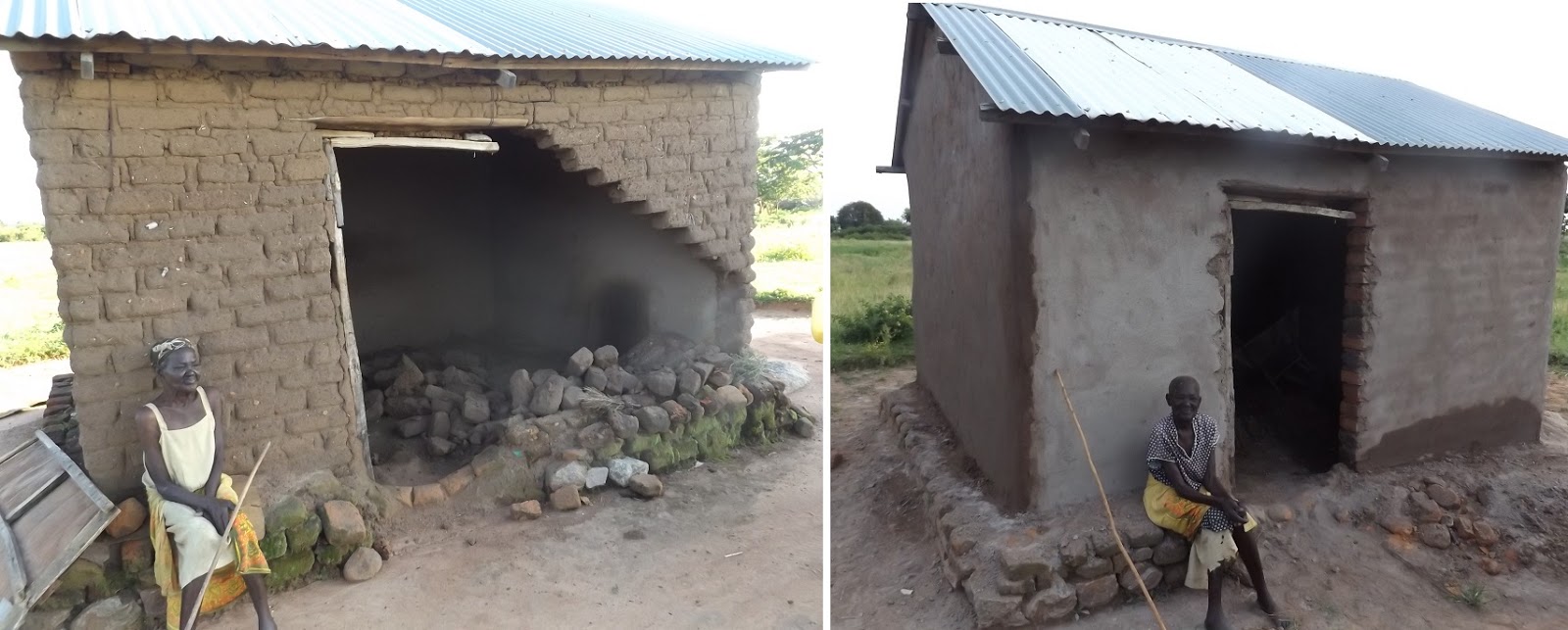
Johanes is almost totally paralyzed, and he has been living in a tiny, dark hut for a long time.  That hut is starting to fall apart, and a friend in the States agreed to pay for a new home for Johanes.  The project started back in March, but ran into problems.  The house was built in traditional style--wooden poles sunk into the ground, then a roof structure built and finished, then the walls mudded.  The contractor who was working on the house assured Fred and Stephen that the small poles he was using would be perfectly fine, but by the time the iron sheet roof was put on and the walls nearly finished, the house was already starting to lean.  The smaller poles couldn't support the weight of the roof.  Below you can see Johanes' current house in the background and the first attempt at his new house in the foreground.

Johanes' neighbors and family members assumed that the leaning house would be "good enough" for him and they prepared to move him into the new house.  Fred insisted that it was not acceptable, and he and Stephen found new thicker poles and had another contractor restart the building a few feet away.  Yesterday eight men and one woman lifted the iron sheet roof off the leaning building and carried over to the new building to be installed.  (No photos because everyone was lifting that heavy roof!)  Here is new house as of yesterday.  The walls should be mudded and ready for him to move in by this weekend, when they will also install a large water tank with a tap inside his home.  Johanes was nearly in tears from his bed in his old house.  He never believed that someone like him could own a house with a metal roof, and he was as amazed as everyone else that Fred and Stephen invested their time and the donor's money in building a proper house that he can live in comfortably for the rest of his years.

Dorina

If you get our monthly emails, you heard that another project funded by friends in America was finished last week.  Dorina's house suffered a lot of storm damage back in April, and I talked about it here.  Last week we got the photos of Dorina with her newly repaired house!  One of the two donors replied to the photo saying "When we can't save the world, we can try...one person at a time!"

Grace and Pita

And finally, one more exciting side project that is coming together is the water tank for a widow named Grace and her daughter, who is blind, and two little grandsons.  A couple who heard our presentation in the States wanted to help with water, so we identified this family.  The first of two large tanks has been installed along with guttering to capture rainwater, and it goes to a gravity-powered tap that blind Pita can operate without assistance.  The donors are so excited about the opportunity to help this family that they have also given a gift to replace the mattress and pay for TB treatment for Pita and also meet some other needs.  They wrote "Just terrific to hear that the small amount of money we sent could help so much."

We often hear about situations like these, where very vulnerable people can transform their lives with a relatively small amount of outside help.  If you'd like to do a project like one of these above, send us an email or comment below so that we can get in touch!  A big thank you to the friends who have made these three projects happen!

12 June 2015

I've Got Clamps! (and a Call to Action)


It has been a while since I've given a Mama Maisha update, but it has been steadily, quietly plugging along, even while I was traveling.  This month we started working with two students, Kathryn and Becky, from the Clinton Global School of Leadership.  They came to us through our partner, Village Life Outreach Project.   Kathryn is working on a study of Barriers to Obstetric Care in Rural Tanzania and Becky is working on a map of contraceptive services in our area, including supply chains and costs.

Meanwhile, our partnership with Mennonite Central Committee is starting to bear fruit!  While I was traveling we received a transfer of funds, and Fred spent last weekend going from pharmaceutical supply shop to shop tracking down all the supplies needed for our first round of birth kits.  These kits are targeted at Traditional Birth Attendants (TBAs), who are not supposed to deliver babies, but in many situations (both emergency and non-emergency), they are still very necessary assistance for women at the time of birth.

We designed the kits with the advice of local TBAs and global health NGOs, and they're designed to bridge many of the gaps that the TBAs identify as keeping them from providing the best possible care when it is too late for a woman to reach a health facility (which may be 30-90 minutes away or more).

Here's a quick tutorial.  The World Health Organization recommends "Six Cleans":

  • Clean Hands of Birth Attendant
  • Clean Delivery Surface
  • Clean Cord Cutting Tool
  • Clean Cord Tie
  • Clean Cloth for Wrapping the Baby
  • Clean Cloth for Warming the Mother
Those last two are already part of the birth culture in East Africa, but we're trying to do what we can to teach TBAs about hygienic practices in the first four areas.  Common practice is that the TBA does not wash her hands, even if she needs to reach into the mother to assess the baby's position.  We've been in numerous TBA homes to see where women deliver, usually on a mat on the dirt floor.  In many rural environments, the umbilical cord is cut with a kitchen knife or a machete, which may still hold trace amounts of animal blood or other contaminants, and the cord is usually tied off with a strip torn off of a khanga, the multipurpose cloth every Tanzanian woman wears as an apron, a jacket, a blanket, a skirt, a head scarf, etc.

Most TBAs, especially those who are retired nurse-midwives or who have received training from some non-profit sometime somewhere, know that gloves and a sterile razor blade are essential.  Even those two tools, which cost about fifteen cents, are sometimes difficult to come by, especially since gloves are usually sold by the box ($3.50-$4 for 50 pairs), putting them outside the financial range of women who usually make about $10-20 a month.  Only the TBA with unusual foresight stocks up on these items in advance on a visit to a larger town.  Most hygienic delivery kits use a bit of twine to tie off the umbilical cord, but the umbilical cord clamp is so simple, so sanitary, so easy to keep clean while on the baby, and so affordable (a nickel a piece) that we determined to try teaching women here to use them instead.  

In addition to
          - latex gloves (clean hands)
          - a hospital grade reusable rubber sheet (clean surface)
          - sterile razor blades (clean cutting tool) and
          - umbilical clamps (clean cord tie)
we also added (on the suggestion of the local TBAs)
                                       - a thick plastic apron for the TBA to wear
                                       - a solar lamp to replace her kerosene lamp
                                       - two plastic basins--one for catching the placenta and one for washing up
                                       - antiseptic liquid to be diluted in water for cleaning up afterward
                                       - and a custom-made metal box to keep it all safe and secure.
All told we're looking at about $93 for each kit to provide 6-12 months worth of clean births.  To refill the kits with the essentials (gloves, razors and clamps) will be about $20 for another 6-12 months worth of services!


Although we are super excited to do the training and deliver these kits, and although we anticipate these kits, along with the basic ones we're putting together for individual mothers, will have a great impact, sepsis from an unsanitary birth environment is not the only cause of death for delivering women. 


Postpartum hemorrhage is a major problem, even in health facilities, where blood reserves are minimal.  According to MamaYe, Tanzania is collecting less than a third of the blood it really needs to have on hand.  Some of you may read my posts about Mama Maisha and think "That's terrible, but there's nothing I can do."  Well, Sunday is World Blood Donor Day, so, even though you may be halfway around the world, go give blood this week in honor of the mothers who need it, including those in rural Tanzania who are dying for lack of it.  Go to the American Red Cross if you're in America, or find your local Red Cross or health facility and GO GIVE BLOOD!  Especially if you live in East Africa and you're reading this, it is so important.  Your local health facility may not even know what to do with someone volunteering to give blood, but make them figure it out!  

Your sacrifice, though small, could save the life of a mother and her baby
-- that's real Mama Maisha!


04 June 2015

Various Fluids I Experienced on a Trip Around East Africa

Step One: Shirati, Tanzania to Mwanza, Tanzania, 180 miles
Our family set off for Mwanza and I dropped them off at the airport.  Fred had a training in Morogoro (a city on the other side of the country) and took Wesley and Gretchen with him.  I spent some time in Mwanza with friends and got ready for my epic road trip.

Step Two: Mwanza, Tanzania to Kigali, Rwanda, 332 miles
This leg started at 5am with a motorbike ride to the bus stand.  Then a 20 minute ride to a ferry, then a boat ride across the bay, then another several hours on the bus, most of which I shared with a very heavy young woman who sweated on me while she slept.  I crossed the border into Rwanda on another motorbike and I jumped into a van to the capital city, Kigali.  (Someone threw up in the back of this van halfway through the journey.) Then another motorbike to the airport to meet up with Lahash and ERM folks...14.5 hours later.
Caregivers of vulnerable children - the woman on the
right is caring for two orphans who were totally abandoned
when their mother died in childbirth
This is what I do for work...take notes.
Meeting with the staff of a new potential partner - ERM
On our last day in Kigali, we met up with Dr. Friessen who was
an elder at my old church and is now helping to found
Africa New Life Seminary.
Step Three: Kigali, Rwanda to Kampala, Uganda, 312 miles
After three days in Kigali, we boarded a night bus to Kampala.  We got on in the evening, got the border a few hours later and arrived in Kampala at 4am.  At some point in the journey, the man next to me fell asleep and urinated in his seat...which was next to my seat...which meant that I got pee on me.
This is what 6am looks like in a bus stage in central Kampala
after 9 hours in a bus and just before 7 more hours on a bus.
Step Four: Kampala, Uganda to Gulu, Uganda, 209 miles
It was about 3pm when we pulled into Gulu, roughly 22 hours after the journey started in Kigali.  It was a good thing we were planning to stop in Gulu, since the bus made a horrible noise and stopped.  We got hotel rooms in a decently nice hotel and crashed.  Our friend Haley was going to drive us the final leg the next morning, and she came to the hotel to hang out with me a bit.  Then we heard noises...loud noises.  Let's just say that there were more fluids of a professional nature in the room down the hall.

Step Five: Gulu, Uganda to Adjumani, Uganda, 73 miles
We drove to a vocational school to interview one of the Lahash students.  On the way there, we encountered what appeared to be a support group meeting for all of the disabled people in Gulu.  I'm just glad I wasn't driving, as Haley maneuvered around a blind old man in the middle of the road and children with cerebral palsy and elderly women in wheelchairs.  It was like an obstacle course from hell.
I got to hold a baby crocodile.  Josh got bit by it, but there was
very little blood. 
I got a lot of quality time with Haley and her husband, Rick.
More glamorous work reviewing school records
We spent many hours in meetings with the team at
Amazing Grace planning for the future of the home.

Step Six: Adjumani, Uganda to Kampala, Uganda, 280 miles
We set off from Adjumani in Susan's car at 6am, during which the only fluid was the lemon yogurt I spilled in my purse.  While we were in Kampala, for approximately 24 hours, we got to hang out with the kids at Kampala House, and I'm pretty sure there was a rat slaughtering a gecko in the corner of my room at 2am.

Step Seven: Kampala, Uganda to Nairobi, Kenya, 427 miles
After Thai dinner, we got on a bus ride that was supposed to be about 13 hours, but ended up being like 16 hours.  We were picked up and dashed around to change money and get coffee (mmm...cappuccino!) before the next leg.

Step Eight: Nairobi, Kenya to Mai Mahiu, Kenya, 36 miles
We visited a new potential partner, Nipe Tumaini (Give Me Hope), for just one night.  It was a fantastic, but too brief time with the team on the farm where they are about to start caring for kids who have been abandoned to the government by their families.

Step Nine: Mai Mahiu, Kenya to Sirare, Tanzania, 218 miles
I spent half an hour on the side of the Mai Mahiu highway at a police roadblock waiting for my bus home...which is how much I was ready to be back home with my family!  I have ridden that bus to the Tanzanian border a dozen times, but it was literally the fastest trip I've ever had, plus more cappuccino!  

Step Ten: Sirare, Tanzania to Shirati, Tanzania, 42 miles
A motorbike to a taxi to another taxi to my very front door!  It was so great to be home with my family after two whole weeks apart.

Summary: 2,109 miles in 75 hours over 15 days
Blood, Sweat, Vomit, Urine, and *ahem* fluids which shall remain nameless, 4 Cokes and 2 cappuccinos

Thanks to Josh and Dan for the photos!