Showing posts with label Traveling. Show all posts

04 August 2016

Coming to America, and I need your help!

In less than two months Wesley and I will be landing in America for eight or nine weeks.  During that trip we'll be based in Newberg, Oregon, but in mid-October to early November we are venturing out on a sub-trip to
  • Madison, WI
  • Grand Rapids, MI
  • Lansing/Holt, MI
  • Detroit, MI
  • Kitchener, ON
  • Lancaster, PA
  • Baltimore, MD
  • Asheville, NC
  • Hamilton/Cincinnati, OH
  • Pittsburgh, PA
and then up to Yakima and Spokane, WA on November .  If you are somewhere along these trails and want to get together or come here me speak, let me know right away!

There are few things that we need help with, though.  The first thing is money.  We need to raise $4,000 to do the whole trip within the next month.  If you could give a gift, large or small, toward that trip, please go to the Lahash donation page for a tax-deductible method, or give via Paypal for a non-tax-deductible method.

The second thing is that I'd love to throw a thank you partner for our financial supporters in the Portland area.  Is there anyone out there who would like to host a party for about twenty people on a date in early October?

Thing Three is, if any of you are cleaning out kids' closets and come across some size 3T/4T girls or 5/6/7 boys clothes, will you set them aside for me?  We really appreciate the hand-me-downs and have to stock up for about two years, so it would be such a help to us.

Finally, I'm really looking forward to seeing a lot of friends while I'm back there, so please get in touch to set up a time to hang out during October or November.  Three weeks are already scratched because of the trip to middle America, so get on the books fast!

Thanks for being the kind of community that we can count on for help in a variety of ways.  We appreciate you all!

09 June 2016

Remembering an Angel

One of my favorite Facebook celebrities is Bunmi Laditan, the creator of the brilliant Honest Toddler website. Today she pointed out how the world is kind of depressing these days, what with the pretty disappointing presidential nominees, sexual assault, white privilege, trolling on the internet, etc.  All this, not to mention the ongoing refugee crisis in the Middle East and Europe and 19 Yazidi girls being executed for refusing to sleep with their ISIS "husbands."  Bunmi shared a story about a couple who helped her out in the grocery store when she was trying to keep from dropping her son and eggs, and she asked for stories of other angels who remind us that the world isn't a wholly dark place.

It made me think of a story that I don't think I have shared here.  Just under two years ago, our family went back to the States for our bi-annual visit.  Since Fred and Innocent hadn't been able to get Canadian visas, they went with Wesley to visit supporters in Pennsylvania while I went up to Ontario with Gretchen.  On my return, our Canadian friends dropped me off at my hotel in Buffalo, NY, from where I was catching a bus to Pennsylvania early the following day.  During the night a freak snowstorm blew in, leaving several inches on the ground and grinding traffic to a halt.  The hotel shuttle wasn't moving and taxis were more than an hour away, so with eight-month-old Gretchen in a carrier on my front, I picked up two suitcases and my messenger bag and set off to catch the metro rail six blocks away.  I couldn't roll my suitcases, especially in the 6-8 inches on the corners of the streets, and I almost gave up several times.  I reached the metro stop in time, but found little shelter from the wind-blown snow.  When the train arrived, I struggled to hurl my suitcases up the steps into the train and follow them. I worried about the two block walk remaining at the other end of my train ride.  When we arrived, an oldish man who seemed under-dressed for the weather picked up my suitcases and with almost no conversation beyond the word "Greyhound" he carried my luggage to the bus station.  I had tears in my eyes, as I seriously don't know if or how I would have managed without his help.  He got me through the doors, asked for nothing, wished me well, and left.

When did an angel cross your path?

17 November 2015

The Wrap Up of My Trip to Kurdistan

Day Eight - A Picnic

We were invited for a picnic at the home of the cousins of The Refuge Initiative's Project Manager.  The group photo at right is only half of the group we had lunch with.  The men in this family work in an informal sector in which they take goods over the mountains and return with sale-able merchandise that is *ahem* untaxed.

After a lovely outdoor lunch in a village halfway to Turkey, we went to see the nearby mountain creek that their drinking water comes from.  I am a little embarrassed at how little I knew about the varied terrain in the Middle East.  This was an incredibly restful and beautiful day.  In fact, I owe an apology to my boss at Lahash, because I'm always skeptical about taking time away from work and relationship to go hiking.  On this afternoon I felt my spirit renewed for another week of engagement with the refugees.  After returning to the house, we heard the wholly miraculous testimony of a Kurdish believer who now lives in Beaverton, Oregon.  His story renewed my faith that God can redeem the worst of men or women (no offense to Sami).

Day Nine - Equal Parts Work and Play

The most distinctly different thing between the Middle East and anywhere else I've ever traveled is that Sunday is a very standard weekday.  We went to a couple of camps in the morning, where I was shown the traditional method for making bread.  The bread is a cross between naan and chapati. This woman kneading bread is the person I learned so much from, although we shared no language in common.  She answered so many questions (through translators) over the course of my visits to their camps, and even when there was no translator, she was so welcoming and comfortable just hanging out in silence.  At dusk we went up one of the mountains in a gondola for Indian and Italian food at a ski resort.  (I didn't mention it, but on our first day of work we went to a resort with a roller coaster which shot over the edge of the mountain at one point--totally exhilarating!)  After dinner a couple who are connected to the staff of The Refuge Initiative came over to probe my knowledge of maternal health by asking for help on getting pregnant and preventing miscarriage.  I gave them all the advice I could (the vast, vast majority of it was extremely practical and not at all medical) and referred them to Dr. Niyan who could refer them to a good OB/GYN.  One of my team members, an actual medical professional, and I had the privilege of laying hands and praying for the mother-to-be.

Day Ten - Politics and Perspective

In the morning we visited the mayor of Soran, who has been incredibly kind and helpful to The Refuge Initiative.  (They've solved some not-inconsiderable problems for him as well.)  A large part of Kurdish culture is militaristic, due to the long, long history of being targeted for destruction by their neighbors.  There is a Kurdish saying that "The mountains are our only friends" because of the many times they have been able to defend themselves against incredible odds due to the rugged terrain.  Nearly every young man (and many young women) volunteer for the peshmerga, a term you may have heard in connection to ISIS, since the peshmerga are the only military which have had success battling ISIS on the ground (and just recaptured Sinjar town from ISIS).

That afternoon some friends of our Kurdish friends came over with their 3-week-old baby who had been crying to the extent that the parents were getting very overwhelmed.  The nurse and I took a look at the baby, who is a healthy and beautiful little girl, and advised the mother on feeding and using simethicone drops.  I also showed her the things that had worked for my kids: abdominal massage and "cycling" her legs to help release the gas trapped in her gut.  Pretty pragmatic stuff, but it felt good to help a fellow mother.

In the evening we got to have a time of worship with the other Western Christians living in Soran.  It was such a blessing to me, since that kind of community is one of the things I really miss here in Shirati.  The stories I heard that evening so inspired me.  I felt as though I were sitting in the room with the kind of missionaries I used to read about.  I can't say more than that, but it really puts the complaints of American Christians "oppressed" for their faith in perspective.

 Days Eleven, Twelve and Thirteen - Maternal Health

At long last I got to tap into my new speciality: maternal health.  Dr. Niyan joined me again to translate the teaching.  She did an excellent job with a difficult task, since she was translating medical and anatomical terminology from English (her 3rd+ language) into Arabic or the Kurdish dialect spoken by the Yezidis.  We taught the women basic reproductive anatomy, the processes of healthy reproduction, some of the most common things that can go wrong and why medical care is important, and finally, we did a simulated "emergency" delivery outside a medical facility.  I had brought hygienic birth kit materials for each camp, thanks to the really kind donors who sponsored my trip, so at each camp the women nominated one older woman to be the keeper of the plastic sheet, gloves, gauze, umbilical clamps and sterile razor blades.

The forty-ish women who sat through our four seminars were so attentive and asked great questions, even about contraception.  Part of the great thing, though, is that there are so few opportunities given to women in these conservative cultures to learn new things, and they were so grateful.  I am so grateful for my dear friend, Dr. Reta Graham, who taught me nearly everything I passed along to those women.  Without Mama Maisha, I would have had so little to offer them, but because of this path that God has been leading me down these past few years, I had the opportunity to minister to so many women from Muslim and Yezidi backgrounds.

After the teaching, Dr. Niyan translated about an hour of questions I had for the women about their former life on Sinjar Mountain and how they had escaped ISIS.  I heard a great story about the cousin of one woman present who had been captured by ISIS and bussed to Mosul with the hundreds of women who have been sold as domestic and sex slaves.  This cousin and her sister were sent to a home where they were put to work.  One evening they actually escaped the house and encountered a taxi driver who agreed to help them.  He knew that he couldn't take them outside the city because the ISIS checkpoints were everywhere, but picnicking in the countryside is a very popular Kurdish pastime.  The driver took the young women to his home, dressed them like local Muslim girls, and packed up his whole family for a picnic in the country.  Once they got outside the city, the driver just drove and drove until they encountered the peshmerga, who took the girls and got them to safety.  (God bless that taxi driver who risked so much to help them!)  Over the few weeks they were at that home, they were never sexually assaulted.  The women telling me the story speculated that this was because the battles for Mosul and the surrounding area were still going on, so the men of that home were more concerned with fighting than with raping two young women.  I appreciated hearing this dramatic story with a great ending, since the vast majority of Yezidi women who are captured by ISIS suffer much worse fates.

The day after I left Kurdistan, I got notification on Facebook that the woman we I mentioned in a prior post had given birth at home in the camp, just two days after Dr. Niyan and I had been there to give education and supplies!  The beautiful little boy is healthy, as is the mother.  Thank God for bringing the blessing of life!

I'm home now, and processing so many, many, many thoughts, especially about refugees and how to respond to the attacks on Paris and the refusal of many American governors to accept Syrian refugees in their states.  I wish you all could meet the hundreds of refugees, male and female, young and old and very young and very old, who are in need of safety, security and support.  Kurdistan is helping so many refugees that the region is literally going bankrupt, but many of my countrymen and women are refusing or protesting these beautiful families whose "crimes" are being born into an ethnic or religious group of which ISIS does not approve.  

I keep thinking: If I were a young child who had been forced from my home by a violent hyper-religious military force and lived in an under-resourced, insecure refugee camp for more than two years (the amount of time it takes to be screened for placement in America), then my family was brought to the United States for safety, refuge, freedom, education, medical care and food, among many other things...well, radicalism of any kind would probably be the last thing I would want to be a part of.

On the other hand, if I had gone through all those things and kept being rejected by these rich Western countries because my ethnicity and religion were not acceptable to them either...well, my perspective on the West and Christianity might be very different.

Please consider supporting The Refuge Initiative, the section of World Orphans that is caring for the refugees we met these past two weeks.  They are doing some of the best, most sustainable and cost-effective development work I've ever seen.  They need your help to provide more holistic services to the families, so please go sponsor a family or contribute to the construction of secure, cinder-block homes to transition refugees out of tents. 

Finally, thank you, especially to all of you who were praying for us and who supported me financially.  This trip was so powerful, and I'm incredibly grateful.


07 November 2015

Days 6 & 7 - Hands on a Belly

We have now done three days of medical clinics in the camps, accompanied by Doctor Nian.  She is a young doctor, just past her residency, and has a great manner with the mostly women and children we are seeing.  On Thursday evening, after seeing 60+ patients in about 2 hours, she gave us a tour of the newest hospital in Soran.  It is only two years old and really amazing, especially coming from Tanzania; she also invited us to her dorm room-sized apartment at the hospital.  Then yesterday, after spending almost three hours in a camp, she and her cousin cooked a dinner of Kurdish food for our entire team and another team that arrived Thursday night.  All told, they fed 24 people!  Somehow I completely forgot to take photos of dinner, but it was delicious, and I carried home a plate of layered dessert composed of--no joke--cookies, vanilla pudding, strawberry jello and banana slices...not a traditional Kurdish dish!  Dr. Nian is fast becoming a friend, and is someone I feel honored to serve alongside.


At the camp we went to Friday morning, there were two pregnant women.  One is only two or maybe three months along, but this beautiful woman is 8+ months with her fifth child.  She very graciously allowed me to palpate her abdomen.  I’m still learning how to tell the position of the baby this way, but it was really an honor to be allowed to touch her and interact with her in this way.  After clinic was over, we drank tea with the older ladies and a few young ones who floated in and out, and Dr. Nian translated my questions about pregnancy and birth culture for Yezidi women.  I learned that most of the children under age 12 were born in hospitals, but that they used to deliver all their children at home with a few designated older women.  They said that sometimes mothers died during that time from post-partum hemorrhage or retained placenta.  When they fled from Sinjar Mountain a year and half ago, several women in their community were pregnant and delivered at different points in the long journey from their home to the camp outside of Soran where they now live.  They told me that as they were traveling, they saw a woman who was trying to reach Turkey deliver twin boys on the side of the road and she “left them by the sea.”


The elders at all of the camps have agreed for me to come and teach their women about maternal health next week, and perhaps I’ll also get to hear more individual stories from them.  I hope to hear what they have experienced and share some of that with all of you.  It can be healing to tell one’s story and have it matter to people, so if I can be a vehicle or vessel for some of that healing, it would be an honor.


The Kharnum Mahmood Kharnum FamilyMany of the families in the Akoyan camp that we visited yesterday are still living in U.N. tents, although the men have been doing construction work and were gifted with enough cement bricks to build a few houses.  Winter is nearly here; soon there will be snow on the ground, and some of the tents are torn and falling apart.  If you are moved by the experiences I’m sharing, please consider going to the World Orphans website to support the work they are doing with these refugees.  You can give one-time gifts by clicking here, or you can click on the photo at right to sponsor the family of the woman who is expecting a new baby next month.


I’m just past the halfway mark of this trip, and feeling pretty strong.  Thanks for your prayers and for following these stories.

04 November 2015

Days 4 & 5 - A Parachute and a Mountainous Climb

Day 4 - P.E. Class at The Refuge

As I mentioned in the last post, The Refuge is the community center that World Orphans staff built here in Soran, Kurdistan, Iraq.  Six days a week teachers and social workers host children from the refugee camps, about 155 in total, who come in three shifts, based primarily on age.  We were there for two shifts yesterday, and played a bunch of games that took me back to the grade school gymnasium, including the most coveted of gym activities: playing with the parachute.  It was so fun to see the kids just enjoying being kids!  The Shabak Kurdish kids are rowdy and love having their photos taken (see below).  The Yezidi kids in the second group were much calmer, much more reserved, but even they warmed up to Red Light Green Light!
      Our afternoon was spent in the local bazaar buying medicine and paint and cookies.  I had to keep reminding myself not to wander off from the group, because I so wanted to just browse through all the shops and look for some of the great foods we've been eating, like pomegranate syrup and ketchup substitute of date sauce.  We've been eating so, so well here, and appreciating the offer of sweet black tea at every home and restaurant after every meal.

Day 5 - Mountain Top and Antibiotics

 We woke up early this morning for a hike.  I went, even though hiking is not my favorite thing, and was very well rewarded for my efforts.  First, I wussed out about ten minutes in and got a ride for three-quarters of the way up the peak.  This was humbling and really good for my pride.  When we got out of the car, we met two shepherds and heard from this older gentleman about his whole life spent in the Kurdish mountains.  The Kurdish people have a saying: "The mountains are our only friends."  I was so ignorant as to Middle Eastern geography and topology that I was stunned by the views at the top of the mountain peak.  I truly had not expected such dramatic and beautiful vistas, and I was greatly moved imagining the many refugees who have crossed similar terrain with babies and children, pregnant mothers and the elderly.  We even heard about a 70+ year old couple who had been forced off of Sinjar Mountain, where the Yezidis lived.  The man had to crawl 20 kilometers (about 12 miles) on hands and knees because he couldn't walk, and the woman didn't own shoes, so she made foot coverings out of water bottles.

We had a time of worship and prayer at this incredible spot, then we were invited in for tea with the guard who is posted at the cell phone tower that marks this particular peak.  He is part of the Kurdish Army, known as the Peshmerga, and was a warm and generous host.  I think he was eager for the company, even though most of us couldn't communicate clearly with him.

In the afternoon, the guys on the team went back to The Refuge to paint some outbuildings, and the ladies on our team (with one guy) went out to one of the camps that we visited on the first day (Kawlokan and Kawlokan Expansion).  We had a stash of medicines to treat common ailments, and a lovely young doctor (in the red sweater) to diagnose.  I had planned to do some maternal health discussions with these women, but instead we focused on serving the 60 women and children (and four men) who came for treatment.  At Kawlokan Camp, where the Shabak Kurds formerly of Mosul live, the complaints were minor and pretty easily treated, but at the second camp, where Yezidis live, it was heartbreaking.  They had several medical issues beyond our reach.  One family really touched my heart.  We have been hearing about how the Yezidis are such an insular community that marrying close relatives is very common.  We saw two children, brothers, in the camp today who are severely mentally handicapped.  The older boy, about age six or eight, was cheerful and a bit aggressive, but the two-year-old had very jerky physical movements, trouble focusing his eyes, scratches and sores all over his face, probably from his own flailing arms.  I held him in my arms for a bit, with tears on my face, and prayed for God to heal his body and mind.
The Khalid Qasim Alias Family
I just went online and saw that some wonderful friends have fully sponsored the Yezidi family I linked to a few days ago!  When I shared with the World Orphans staff here on the ground, they were so excited and blessed.  I'm asking more of you to get involved.  This is the family with the two disabled boys.  Sponsorship through World Orphans is safe and very effective, and may enable long-term care and counseling for these boys.  Please click on their photo to go to the website and sponsor them!

Please continue to pray.  I am feeling so deeply moved, but also refreshed and blessed to be serving alongside a great team and very devoted servants who live here.   I'm remaining with 10 days, which is a long time to sustain these heavy emotions.  Bless you all.  Thanks for paying attention.

02 November 2015

Day 3 - Visiting the Camps

Today was my third day in Kurdistan, after arriving Saturday afternoon.  I was picked up by two Kiwis, a Brit and an American, all coming from Cypress to come pray in Kurdistan.  They delivered me to the home of Tim and Sarah Buxton, who work for World Orphans, the organization we are here to work with.  The Buxtons have been here for a year and a half with their teammates who have been in this area for five years.  The Buxtons landed in Kurdistan (northern Iraq) on the very day that ISIS took the city of Mosul, so their intention to come do development work and community building quickly became a relief effort to help those displaced by ISIS.

This building, which they call The Refuge, was their original intended mission: a community center where people could come for classes, weddings, etc.  Now it holds a kind of day school for children from their five refugee camps.  (More on the school tomorrow.)  We got a tour of this building and saw the graveled part of the compound where this group hosted their very first group of refugees--twenty Shabak Kurds from Mosul who had been squatting in some houses under construction, but were being evicted by the builder.  The mayor of Soran, a Muslim man who has been supporting the work, asked them to provide a place for these twenty families to put up their UN tents.  In six days, Tim and his colleagues leveled the hilly plot, removing over 100 truckloads of dirt and bringing in 200 truckloads of rock, as well as built a bath house and installed water tanks.  Now these families are in semi-permanent housing in the first camp that we visited (the mostly recently completed).

We had been told that these communities are very protective of their women, but that the women would be very eager to see the women on our team.  Sure enough, when we walked into the camp where the Shabak Kurds are living now, many women came to peek out their doors at us, averting their eyes from the men and staring openly and smiling at us women.  I was beckoned in by a teenage girl holding a 6-8 month old baby and presented to her mother (the baby's mother) and her grandmother.  Her 10 or 11-year-old brother joined us also.  While I played with the baby and drank tea with the grandmother, the girl and her brother played with my camera.  There were no shared languages among us, but I showed them photos of my family and we tried to communicate with one another.  I'm going to see about getting some of these photos printed in town to take back to the family later in the week.  Later I learned that this baby is likely the one who was born while the families were living in the compound at The Refuge.

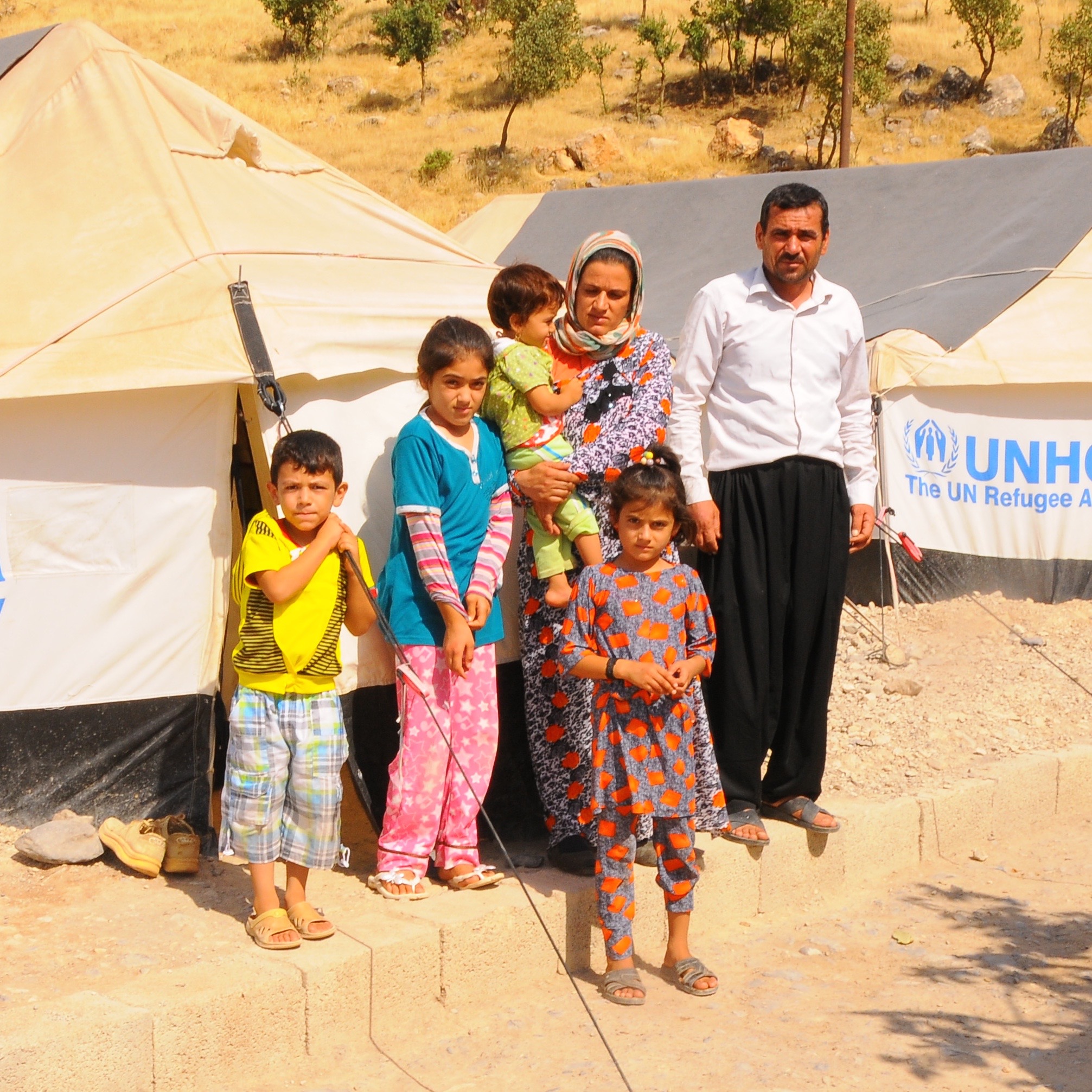
Given my interests in maternal health, naturally I gravitated toward the smallest babies I could find, and in the next camp we visited, one that hosted about a dozen Yezidi families, I met this woman and her little nephew.  A Kurdish Christian from Oregon who is traveling on our team was nearby, and helped me ask a few preliminary questions.  She explained that their family, including the baby's mother, ran from Sinjar Mountain about 18 months ago when this guy was only 20 days old.  Unlike the Shabak Kurds, who had a couple of days' notice to prepare to run, as well as some vehicles to escape in, the Yezidi had only moments to grab their children and run.  This is evident even between these two homes that I visited.  The Shabak women had rugs, blankets, tea cups, even a television.  The woman above, who lives with her teen-aged daughter and other family members, had almost nothing but some cooking supplies and some blankets which they had obtained along the past year and a half they've been fleeing.  They have been in this cement block, three room home constructed by World Orphans and its partners, for only the past four months.  Prior to that they slept anywhere they could find a roof overhead.  Now the winter is coming to these mountains (it's already quite cold, and it's only going to get colder still--snow is on the way in the next month or so) and they have nothing to protect them from the cold cement floor.

This is an aerial view of another camp that we visited, where the nearly 40 families had been living in UN tents, which were ripped to bits in a wind storm six weeks ago.  The World Orphans team mobilized funds to build homes for as many as they could.  This camp has an older style, with separate bath houses, as opposed to the ones that the women above live in, which are self-contained (each has a bathroom and a kitchen).  At this camp we had tea with several Yezidi elders (if you look closely you can see them smoking outside, wearing the traditional red and white headscarf).  The World Orphans Project Coordinator, a Muslim Kurd, is very interested in the work of Mama Maisha and the tools I brought, and he wants me to teach every woman in every camp, so he started by asking these Yezidi elders if I could be allowed to teach their women, and they agreed!  It's a great first step, which needs to be followed by getting a great female translator who can speak the Yezidi dialect.  Not a super easy task, so prayers are appreciated on that front.

This is the fourth camp, which we didn't get to visit today, although we saw it from the top of the soccer stadium.  As you can see, these families are still in tents, and with the snow coming, it's a desperate push to raise funds to get them into the permanent housing.  We'll find out later this week, when Tim's colleague returns with still more visitors, how much money is needed to finish moving all these families into the cement block homes.

Tomorrow we will go to The Refuge to see the kids from the camps in their "school" and we will also visit one last camp.  I'm feeling really great about this trip, although naturally consumed with concern for the families I'm meeting.  I have some cash with me (from the excess you all donated) which I hope to use to bless one or two families in a small way.  Right now I'm thinking about buying a carpet or two, but we'll see how things develop.   

If you feel moved to help these families, the best way to do that is to go sponsor a family. This photo on the left is the Shabak Kurd family who shared tea with me, and the family on the right is the mother who ran with her tiny baby and other children.  Click on their photos to be taken to the site for sponsorship for this family.  World Orphans, like Lahash, spends the vast majority of their money on the ground, which I have seen first hand, and when all these families are sponsored, it will allow the team to offer medical services, better education, needed furnishings and other important things.  It costs about $150 a month to sponsor a family, or you can contribute, along with others, a $30 per month share in the family's support.
The Ismaeel Qasim Alias Family
The Hussein Jimah Muhammad Family
Thanks to all for prayers for good travels and safety, and please continue to pray for Fred and the kids at home and for continued strength in body, mind and spirit for me.

02 July 2015

Get on my Calendar! 30 Appointments Going Fast!


Gretchen and I will be coming to the States for the month of September for three reasons.

1.  10th Anniversary of Lahash International!It's the 10th anniversary of the beginning of Lahash, and September marks my nine-and-a-half year anniversary with Lahash!  I'm coming back to attend the celebration events over Labor Day weekend.  There's a formal banquet (see left) on the evening of the 4th and a picnic reunion on the afternoon of the 5th.

As my boss and I were just discussing, over the years, many of my friends have become staff members, travelers, volunteers and sponsors at Lahash, so I hope I'll be seeing many of you over the Labor Day weekend.

2.  Meet the Board of Mama Maisha USA!
Last month Mama Maisha was registered as a U.S. non-profit!  We have a board of directors based in Asheville, North Carolina, so I'll be flying out to meet up with them and maybe do some fundraising for our brand new official organization.

3.  Increase our Personal Support
Fred and I are both in unenviable position of fundraising our salaries.  Fred does this through writing grant requests for projects which pay him a salary (like the GBV reduction program I referenced last week).  My salary from Lahash International is 100% fundraised, including all my travel expenses (like my trip around East Africa in May).  Beyond our "jobs" we like to do projects to help vulnerable people in our community, like Dorina, Grace and Johanes.  All of the money that pays for our international travel, personal ministry and my work with Lahash International comes from individuals and families supporting us through monthly or annual donations.

If you have been touched by our ministry in East Africa, I would like to schedule a time to meet with you during the month of September.  These meetings will be my top priority, and my goal is to meet with 30 people in 30 days.  I won't be doing much socializing, but I will be accepting lunch and dinner invitations, coffee dates, early morning breakfasts or Sunday brunches with any person, couple or family who would like to talk about joining our support team.  If you want to be on that list, email leishao@lahash.org right away to schedule a day.  There are only 30 spots, and they're going to fill fast!

Now I'm off to a birthday party for one of Mama Maisha's interns from Clinton School of Public Service, then a good night's sleep before teaching two full-day workshops on "Hygienic Birth When the Hospital Can't Be Reached" to Traditional Birth Attendants.  As I remarked on Facebook, if a pregnant woman rushes into the church hall needing assistance to deliver, I'll probably be the least qualified person to actually deliver the baby, but I'm still the teacher of the course.  That's how desperate rural Tanzania is for education on issues of maternal mortality!  Be sure to check back next Thursday to see how I did!


04 June 2015

Various Fluids I Experienced on a Trip Around East Africa

Step One: Shirati, Tanzania to Mwanza, Tanzania, 180 miles
Our family set off for Mwanza and I dropped them off at the airport.  Fred had a training in Morogoro (a city on the other side of the country) and took Wesley and Gretchen with him.  I spent some time in Mwanza with friends and got ready for my epic road trip.

Step Two: Mwanza, Tanzania to Kigali, Rwanda, 332 miles
This leg started at 5am with a motorbike ride to the bus stand.  Then a 20 minute ride to a ferry, then a boat ride across the bay, then another several hours on the bus, most of which I shared with a very heavy young woman who sweated on me while she slept.  I crossed the border into Rwanda on another motorbike and I jumped into a van to the capital city, Kigali.  (Someone threw up in the back of this van halfway through the journey.) Then another motorbike to the airport to meet up with Lahash and ERM folks...14.5 hours later.
Caregivers of vulnerable children - the woman on the
right is caring for two orphans who were totally abandoned
when their mother died in childbirth
This is what I do for work...take notes.
Meeting with the staff of a new potential partner - ERM
On our last day in Kigali, we met up with Dr. Friessen who was
an elder at my old church and is now helping to found
Africa New Life Seminary.
Step Three: Kigali, Rwanda to Kampala, Uganda, 312 miles
After three days in Kigali, we boarded a night bus to Kampala.  We got on in the evening, got the border a few hours later and arrived in Kampala at 4am.  At some point in the journey, the man next to me fell asleep and urinated in his seat...which was next to my seat...which meant that I got pee on me.
This is what 6am looks like in a bus stage in central Kampala
after 9 hours in a bus and just before 7 more hours on a bus.
Step Four: Kampala, Uganda to Gulu, Uganda, 209 miles
It was about 3pm when we pulled into Gulu, roughly 22 hours after the journey started in Kigali.  It was a good thing we were planning to stop in Gulu, since the bus made a horrible noise and stopped.  We got hotel rooms in a decently nice hotel and crashed.  Our friend Haley was going to drive us the final leg the next morning, and she came to the hotel to hang out with me a bit.  Then we heard noises...loud noises.  Let's just say that there were more fluids of a professional nature in the room down the hall.

Step Five: Gulu, Uganda to Adjumani, Uganda, 73 miles
We drove to a vocational school to interview one of the Lahash students.  On the way there, we encountered what appeared to be a support group meeting for all of the disabled people in Gulu.  I'm just glad I wasn't driving, as Haley maneuvered around a blind old man in the middle of the road and children with cerebral palsy and elderly women in wheelchairs.  It was like an obstacle course from hell.
I got to hold a baby crocodile.  Josh got bit by it, but there was
very little blood. 
I got a lot of quality time with Haley and her husband, Rick.
More glamorous work reviewing school records
We spent many hours in meetings with the team at
Amazing Grace planning for the future of the home.

Step Six: Adjumani, Uganda to Kampala, Uganda, 280 miles
We set off from Adjumani in Susan's car at 6am, during which the only fluid was the lemon yogurt I spilled in my purse.  While we were in Kampala, for approximately 24 hours, we got to hang out with the kids at Kampala House, and I'm pretty sure there was a rat slaughtering a gecko in the corner of my room at 2am.

Step Seven: Kampala, Uganda to Nairobi, Kenya, 427 miles
After Thai dinner, we got on a bus ride that was supposed to be about 13 hours, but ended up being like 16 hours.  We were picked up and dashed around to change money and get coffee (mmm...cappuccino!) before the next leg.

Step Eight: Nairobi, Kenya to Mai Mahiu, Kenya, 36 miles
We visited a new potential partner, Nipe Tumaini (Give Me Hope), for just one night.  It was a fantastic, but too brief time with the team on the farm where they are about to start caring for kids who have been abandoned to the government by their families.

Step Nine: Mai Mahiu, Kenya to Sirare, Tanzania, 218 miles
I spent half an hour on the side of the Mai Mahiu highway at a police roadblock waiting for my bus home...which is how much I was ready to be back home with my family!  I have ridden that bus to the Tanzanian border a dozen times, but it was literally the fastest trip I've ever had, plus more cappuccino!  

Step Ten: Sirare, Tanzania to Shirati, Tanzania, 42 miles
A motorbike to a taxi to another taxi to my very front door!  It was so great to be home with my family after two whole weeks apart.

Summary: 2,109 miles in 75 hours over 15 days
Blood, Sweat, Vomit, Urine, and *ahem* fluids which shall remain nameless, 4 Cokes and 2 cappuccinos

Thanks to Josh and Dan for the photos!