Showing posts with label Mama Maisha. Show all posts

19 May 2016

10 Great Things in the Past 3 Months

It seems appropriate to resume blogging today, the EIGHTH ANNIVERSARY of starting this blog!!  Here's a link to the very first blog post. Now read on for a sadly overdue update.

1. We built a house.

A family in Oregon paid for a new house for a widow with small children. She is one of the clients who we visited back on Christmas Day. In February, Fred organized several women in the community to volunteer making mud and a few construction professionals came in to do the specialty work. After the house was finished, two friends bought Benta a bed and mattress and new kitchen things. The family is so much more secure and happy than they were six months ago!

2. Mama Maisha expanded to 3 new villages.

 With the generous support of the community of Mama Maisha donors in the Asheville, NC area, we were able to expand to three new villages in February.  The village of Kyangasaga is about half Muslim and the vast majority of women deliver at home.
The village of Lwanda (our community leader meeting is pictured here...I had no house help that day, so the kids had to come with me!) say they never receive help from outsiders and they are so excited to work with us.  The village of Nyahera is familiar to me because our friend Stephen and many of the poor clients we get to serve live in this village.

3. Wesley turned 4!

We can't believe this kid is growing up so fast.  He got a remote-controlled car, which he was very excited about.  He's dealing with the drama of feeling all the feelings, but not sure how to process that.  He's strong-willed and very loyal. His favorite people are the young men who drive motorcycles and taxis.

4. We had visitors from Mama Maisha US.

In March we were joined by our co-founder, Dr. Jeff, and one of his colleagues, Dr. Marina, and they helped us with training of our Maternal Health Advocates.  After a great few days with our existing and new MHAs, we spent the next week visiting each of our villages. 
In Nyahera we had a men's community meeting to talk about their questions about contraception.  In Kyangasaga over 150 women showed up to hear about maternal health. One-third of those women were pregnant and received a birth kit as a gift for registering with our new MHAs.  In Nyambogo we visited some TBAs, demonstrated the implant form of birth control, and took photos with these infant twins, named Barry and Leisha, who were born prematurely and got supplementary milk support through us.  We also served as an ambulance from this remote village for a young woman who had been tossed by a bull and was suffering a concussion.  In Lwanda we trained Traditional Birth Attendants and drove through a ravine to visit the closest health facility. It was in Lwanda when I gritted my teeth, crossed my fingers, and gunned it through a puddle as wide as the road.  My teammates dubbed me Han Solo and our hired car the "Millennium Falcon."  In Roche we doubled up on motorbikes to make it down the cow paths to another community meeting where I gave advice about how men could get their wives to have more sex, among other things.

5. Inno came home for holidays.

We were so happy to have Innocent home during April! The kids had a lot of fun playing together, and he was a big help with the little kids. Fred was traveling a lot during April, so having another pair of slightly-bigger hands to help out was great.  He started at a new school (again) back in January, and he has adjusted so quickly! He was selected to be the "Class Senator" which is kind of like the class prefect, and he's number two in his class as well.

6. We celebrated 5 years of marriage.

We got away for about 30 hours to Musoma to celebrate at a small hotel on the lake.  It's been a wonderful five years, and I'm so grateful to be sharing this adventure with Fred. 


7. We distributed food to needy families.
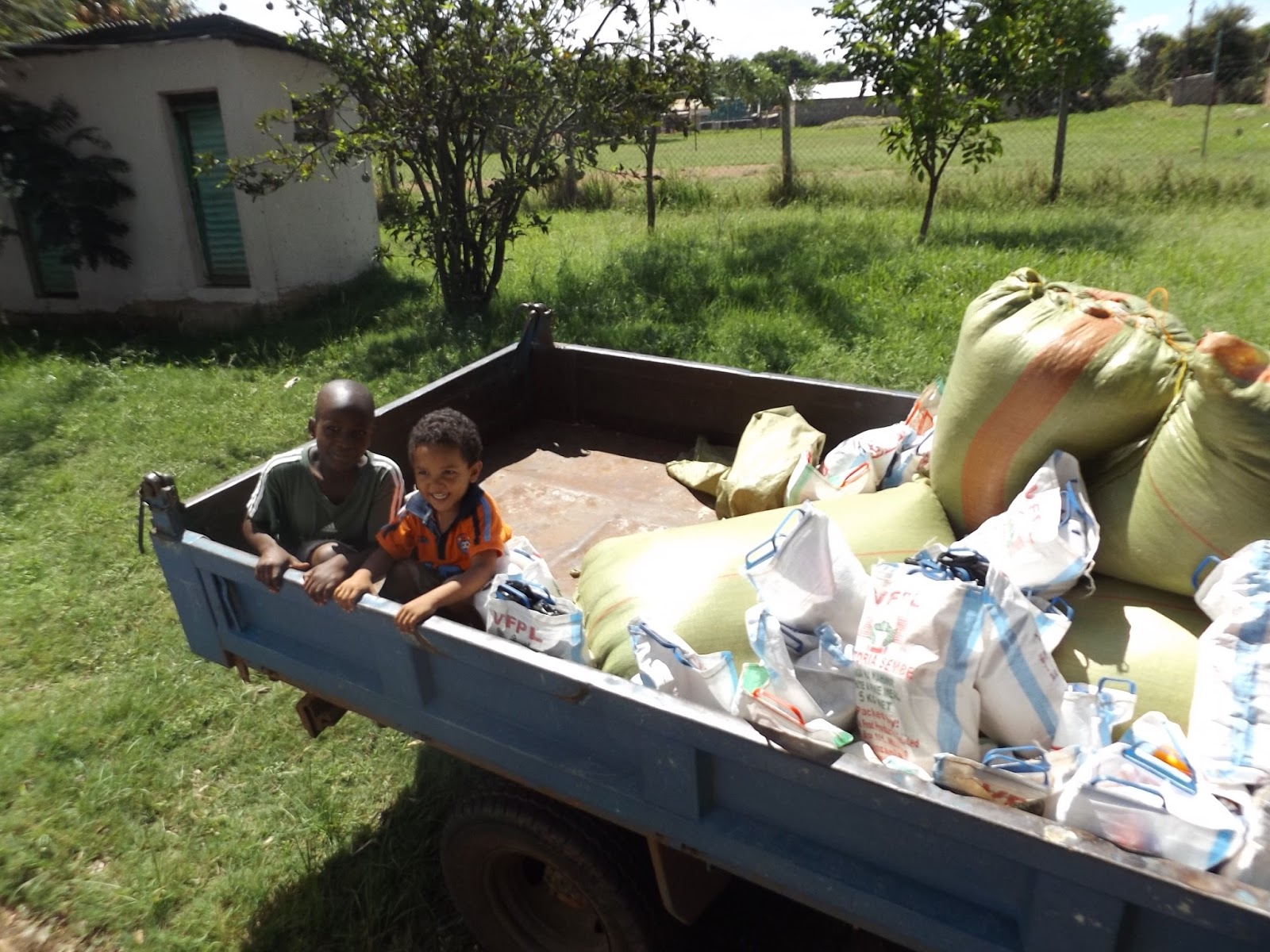
A small church in Medical Lake, Washington, raised money to provide some food for needy families.  In April, our whole family got to be part of the first distribution of that food.  We met widows and widowers and representatives from child-headed households and paralyzed patients. Each family got maize and beans, salt and oil. After a few more months we will arrange another distribution.
Thank you, Makarios Fellowship!

8. We bought a car!

Actually, I should say that we were given a car.  In less than six weeks, we raised $10,000 to purchase a 24-year-old Toyota LandCruiser in good condition. Many friends gave toward this amazing gift, and we are so grateful.  It is already making our life so much easier, and we are eager to use it for village visits for Mama Maisha and for our other clients.

9. We moved to Mwanza.

At the end of April we finished packing up five years of life in Shirati and moved to Mwanza, Tanzania.  It's a city right on Lake Victoria, about five hours south of Shirati.  
Fred has taken a job doing program development with the African Inland Church of Tanzania, Mwanza Diocese.  He's busy launching new programs, many of them based on relationships he developed with people we worked with in Shirati.  It's great to see so many people appreciating my husband's work ethic, creative ideas for improving people's lives, and his strict truthfulness regarding finances and outcomes. He's getting into working with people with albinism, doing more training for trauma healing, and helping implement a program to provide income generation for people in rural communities.  
We're living in a church guest house while we wait for our church house to be ready (probably about six months), and the kids are loving their new house, especially since they get to hang out with their friends, Kaleb and Micah, so much more.  I have been networking with other organizations which are doing similar work to Mama Maisha and preparing for the upcoming Lahash East Africa Conference, which will be here in Mwanza.

Check back next week to read about a few things that are upcoming!


16 October 2015

When Babies Don't Cry

Last week we had visitors from Village Life Outreach Project in Cincinnati, Ohio--an organization which was instrumental in helping Mama Maisha get started.  Every October they bring a team of medical professionals and students to do mobile clinics in villages around Shirati.

One of the nurses, Tina, who has 37 years of experience in obsterics, offered to do a training for Traditional Birth Attendants about the principles and skills of the Helping Babies Breathe curriculum.  Last Saturday we went out to Nyambogo village with Tina, a pediatrics nurse named Megan and a pediatrics resident named Sara.  They taught twelve TBAs how to help a baby breathe immediately after birth using only some blankets and a bulb syringe.

These TBAs are, on average, over 60 years of age and uneducated, so it is always inspiring to see them shamelessly put themselves out there to learn new skills and techniques and tools in order to help the mothers and babies they serve.  Several of the women really struggled to learn the technique of using a bulb syringe on a plastic baby, but they committed themselves to mastering this new skill.  They told us they appreciate this training because it is so much more effective than having a mother who has just exhausted herself delivering a baby then suck the mucus out of the baby's mouth and nose.


We are excited to track down enough bulb syringes for all of these TBAs and get this same training for the rest of the 28 women we have been training to improve the available delivery services for pregnant women in rural Tanzania!


21 August 2015

A Literal Miracle Happened This Week!

If you're not of a theological bent, I suppose this event could be ascribed to a series of coincidences, but personally think that God had a hand in pointing the people to the place at the time, and as a result, a miracle happened.

On Wednesday this week the Mama Maisha Coordinator and Advisor went out to one of our target villages to do a training for more Traditional Birth Attendants about how to use the Hygienic Birth Kits we are providing through a grant from Mennonite Central Committee.  They went with a Dutch medical resident who is volunteering at Shirati Hospital and wanted to see what Mama Maisha is all about.  Well, she had a front row seat!

When they arrived in Nyambogo, they were notified that there was a young woman in labor at our Maternal Health Advocate's house.  Every time we have gone to Nyambogo we have met a woman in labor, and this village has no health facility at all.  (We walked to the closest health facility, 10 km away, a few weeks ago.)  So Victoria, the medical resident, and Ellen, our Advisor who is a retired nurse-midwife, went over to check the 19 year old first-time mother.  She was very close to delivery, so they couldn't put her in the car and send her to a health facility.

The woman was a few weeks premature and very unprepared for delivery.  She didn't even have a khanga (a ubiquitous cloth which can be used for everything from an apron to a diaper to a menstrual pad) with her, but our staff happened to be there with over 100 hygienic birth kits!  Victoria, under the coaching of Ellen and with the assistance of five Traditional Birth Attendants, used the kit to deliver the baby!  There was a tense moment which led to Victoria doing an episiotomy to ease the baby's entrance, and if she hadn't had a birth kit, she would not have had the tools for that, and the mother would have torn badly or the baby would have remained stuck in the birth canal.

After the tiny baby entered the world, she wasn't breathing well for the first few minutes.  In a village as remote as Nyambogo, if that baby had had any problems getting her breath, there was almost nothing they could do for her and no chance, even with a car, to reach the hospital in time.  Moments passed and they prayed and held their own breaths to help this little miracle breathe, and she did.  She cried and took some deep breaths and started nursing to everyone's relief.

In many African cultures the baby is not named until he or she is born.  Much of this comes from the traditionally high infant mortality rate, as well as a very spiritual culture in which people fear curses upon the mother and her baby.  This baby, a little girl, had no name when she was born, but due to the role of this visiting Dutch almost-doctor, there's a new little baby Victoria in Nyambogo village!


23 July 2015

The Tragedy of Being a Mother in Rural Tanzania

This week we encountered the stories of three women, three typical and tragic stories.

The first woman came into our lives through the Gender Based Violence program.  Her husband beat her so badly that he broke her leg.  Then he kept her at home and prevented her or anyone else from seeking care for her.  The broken leg became infected, then gangrenous.  Finally she was taken to the hospital, where she stayed for more than one week, during which time apparently no one from the hospital treated her or cleaned her wound.  I saw a photo of the bed she was left sleeping on, which was soaked in fluids from her bed.  She was left alone in a room, in terrible pain, with no treatment for the infection in her leg and little pain medication.  When the hospital staff saw the police and GBV team on their way to the woman's room, they rushed to bandage her leg.  It had been too late to save the leg even before she reached the hospital, and this pregnant mother of four had her leg amputated last week.  The GBV Coordinator has been trying to intervene with the family and in-laws to care for her and her children, but while they look for money for a hospital bill and food for the patient and for her children back at home, the woman is hungry in the hospital, which doesn't have food services for patients.  Her husband is on the run, and the police are looking for him.

The second woman I met in Nyambogo on Tuesday.  The Mama Maisha team was there to walk from the village center to the nearest health clinic, but before we set out, our Maternal Health Advocates brought us a woman who delivered locally two weeks ago.  The baby was very healthy, but she has a birth defect which seems to have fused her elbows and her forearms are tiny.  The mother was at a loss what to do.  Grace, the Mama Maisha Coordinator, is friends with the hospital physio therapist, who agreed to examine the baby, so we gave the mother a ride to Shirati and Grace accompanied her to the hospital.  Amazingly, this was the second baby George had seen in two days with the exact same birth defect.  They have to wait until the babies are six months old, and a surgeon will perform the operations.  Now this mother has six months to find the money for surgery and a hospital stay and physical therapy for goodness knows how long.

The third woman came to our attention through our friend Stephen.  We have visitors from Canada this week who have been doing home improvements for vulnerable families in the villages around Shirati.  Their schedule for today was to go build a new mud hut for a very sick widow with HIV and two children.  Their idea was to build a house that the children could live in even should their mother die.  Last evening we got word that the woman died, leaving her children as orphans and virtually homeless, since the funeral preempts the building of a new house before the Canadians leave on Saturday.

Life in East Africa is not easy, but for women, the burden of illness and poverty is multiplied by the effects on their children.  There are many good men here, but cultural traditions often leave mothers alone carrying the burdens alone.  There have been some good stories this week, but these three mothers have weighed on my heart.  There is nothing we can do to change their circumstances, but we can try to help share the burdens.  

It looks like the orphaned children will get their house tomorrow, thanks to the Canadian friends, but the 14-year-old boy will be the head of household now.

We don't know the actual costs yet, but baby Bibi Peter will need financial support for her surgery, probably around $500 within the next six months.

The now-single mother of four (almost five) is on her way home to a new life without a husband and without a leg.  The hospital bill will be about $200, and unfortunately, their poverty will only worsen with the absence of a husband and the presence of a disability.  She has been doing a business of collecting and selling firewood, but this is impossible while on crutches.  Training for a new career as a seamstress or doing hair would be about $100.

If you are willing to help one of these families, you can give tax-deductibly by clicking here or by sending us a check (written to Leisha Adams, sent to Sam Adams, PO Box 982, Newberg, OR 97132) or by giving to fredandleisha@gmail.com on Paypal.

12 June 2015

I've Got Clamps! (and a Call to Action)


It has been a while since I've given a Mama Maisha update, but it has been steadily, quietly plugging along, even while I was traveling.  This month we started working with two students, Kathryn and Becky, from the Clinton Global School of Leadership.  They came to us through our partner, Village Life Outreach Project.   Kathryn is working on a study of Barriers to Obstetric Care in Rural Tanzania and Becky is working on a map of contraceptive services in our area, including supply chains and costs.

Meanwhile, our partnership with Mennonite Central Committee is starting to bear fruit!  While I was traveling we received a transfer of funds, and Fred spent last weekend going from pharmaceutical supply shop to shop tracking down all the supplies needed for our first round of birth kits.  These kits are targeted at Traditional Birth Attendants (TBAs), who are not supposed to deliver babies, but in many situations (both emergency and non-emergency), they are still very necessary assistance for women at the time of birth.

We designed the kits with the advice of local TBAs and global health NGOs, and they're designed to bridge many of the gaps that the TBAs identify as keeping them from providing the best possible care when it is too late for a woman to reach a health facility (which may be 30-90 minutes away or more).

Here's a quick tutorial.  The World Health Organization recommends "Six Cleans":

  • Clean Hands of Birth Attendant
  • Clean Delivery Surface
  • Clean Cord Cutting Tool
  • Clean Cord Tie
  • Clean Cloth for Wrapping the Baby
  • Clean Cloth for Warming the Mother
Those last two are already part of the birth culture in East Africa, but we're trying to do what we can to teach TBAs about hygienic practices in the first four areas.  Common practice is that the TBA does not wash her hands, even if she needs to reach into the mother to assess the baby's position.  We've been in numerous TBA homes to see where women deliver, usually on a mat on the dirt floor.  In many rural environments, the umbilical cord is cut with a kitchen knife or a machete, which may still hold trace amounts of animal blood or other contaminants, and the cord is usually tied off with a strip torn off of a khanga, the multipurpose cloth every Tanzanian woman wears as an apron, a jacket, a blanket, a skirt, a head scarf, etc.

Most TBAs, especially those who are retired nurse-midwives or who have received training from some non-profit sometime somewhere, know that gloves and a sterile razor blade are essential.  Even those two tools, which cost about fifteen cents, are sometimes difficult to come by, especially since gloves are usually sold by the box ($3.50-$4 for 50 pairs), putting them outside the financial range of women who usually make about $10-20 a month.  Only the TBA with unusual foresight stocks up on these items in advance on a visit to a larger town.  Most hygienic delivery kits use a bit of twine to tie off the umbilical cord, but the umbilical cord clamp is so simple, so sanitary, so easy to keep clean while on the baby, and so affordable (a nickel a piece) that we determined to try teaching women here to use them instead.  

In addition to
          - latex gloves (clean hands)
          - a hospital grade reusable rubber sheet (clean surface)
          - sterile razor blades (clean cutting tool) and
          - umbilical clamps (clean cord tie)
we also added (on the suggestion of the local TBAs)
                                       - a thick plastic apron for the TBA to wear
                                       - a solar lamp to replace her kerosene lamp
                                       - two plastic basins--one for catching the placenta and one for washing up
                                       - antiseptic liquid to be diluted in water for cleaning up afterward
                                       - and a custom-made metal box to keep it all safe and secure.
All told we're looking at about $93 for each kit to provide 6-12 months worth of clean births.  To refill the kits with the essentials (gloves, razors and clamps) will be about $20 for another 6-12 months worth of services!


Although we are super excited to do the training and deliver these kits, and although we anticipate these kits, along with the basic ones we're putting together for individual mothers, will have a great impact, sepsis from an unsanitary birth environment is not the only cause of death for delivering women. 


Postpartum hemorrhage is a major problem, even in health facilities, where blood reserves are minimal.  According to MamaYe, Tanzania is collecting less than a third of the blood it really needs to have on hand.  Some of you may read my posts about Mama Maisha and think "That's terrible, but there's nothing I can do."  Well, Sunday is World Blood Donor Day, so, even though you may be halfway around the world, go give blood this week in honor of the mothers who need it, including those in rural Tanzania who are dying for lack of it.  Go to the American Red Cross if you're in America, or find your local Red Cross or health facility and GO GIVE BLOOD!  Especially if you live in East Africa and you're reading this, it is so important.  Your local health facility may not even know what to do with someone volunteering to give blood, but make them figure it out!  

Your sacrifice, though small, could save the life of a mother and her baby
-- that's real Mama Maisha!


24 April 2015

Mama Maisha Partners with Mennonite Central Committee!

Of course I forgot to take any picture at all, but earlier this week Mama Maisha has been hosting Tiffanee Wright, the Health Coordinator for Tanzania Mennonite Central Committee (MCC).  MCC approved a proposal we wrote to supply hygienic delivery kits to Traditional Birth Attendants and delivering mothers.

We're so excited to roll out this project.  The first thing will be doing a training for the Traditional Birth Attendants to teach them the principles of clean hands, clean perineum, clean delivery surface, clean cord cutting instruments, clean cord tying instrument and clean cutting surface, then we'll train them and give them supplies to support women who cannot reach a health facility at the time of delivery.

We will also have funds to put together individual kits for women who may not reach a health facility with skilled care.  Two months ago I wrote about a visit to one of our villages which has no health facility, and we were emptying our pockets to find soap and razor blade and fare for a motorcycle taxi to a TBA.  In the future, it would be so great for us to be able to have a bunch of kits with the TBAs and our MHAs and the nurse we hired to go out to do village prenatal care.

We had a great time in Nyambogo village Wednesday with Tiffanee, and yesterday we signed a Memorandum of Understanding for the project.  We're excited about the opportunity to partner with such a great organization!

24 February 2015

More Mama Maisha stories + photos

For the past week, my co-founder and dear friend, Dr. Reta Graham has been in Shirati with two other colleagues.  We've been going out to the villages where Mama Maisha is getting established, and it has been an extremely poignant time for us.
First we went for a meeting of women's group members in Roche Village.  Over 90 women came!  We've only been working with the village women for 3-1/2 months, and on one week's notice, our Maternal Health Advocates had mobilized over 90 women of child-bearing age to come hear a seminar on Healthy Pregnancy, Safe Delivery and Family Planning.  There were so many beautiful women with pregnant bellies and tiny babies, and it did our hearts so much good to sit with them and answer questions and hear stories.  The lady in the orange and black and white striped dress told me she's going to name her baby girl after me!  We'll see if it really happens, but it would be an incredible honor.

After several hours with those ladies, we went for a "short" walk (about 30-40 minutes each way in the blazing hot sun) to the home of a Traditional Birth Attendant and saw the dark, windowless room and the straw mat where she delivers babies.
The next day we went to Burere Village for another meeting with clients (below).  The program hasn't been so dramatically successful as quickly as in Roche, but we still had a great time with the ladies who came.
 On Friday we went to Nyambogo Village to do a facilitated discussion with a group of TBAs.  This village has no health services at all, so the women really rely on the TBAs.  They were so interesting and interested in anything we could share with them, and they looked lovely in their colorful dresses.
As we sat and drank sodas with them, we asked how they got started in this work, and several of them shared stories about how they had dreamed that Jesus called them to deliver babies.  I loved hearing how they see this health care service as a kind of spiritual service and ministry.  I'm sure the women they serve are grateful for the gentleness and maturity that the TBAs bring to the bedside.

After a fun, restful weekend showing my new friends around Shirati, we headed back to Roche this morning for a great meeting with the Maternal Health Advocates.  We heard a lot of their struggles and the obstacles that women in their village are facing; sometimes stories sad enough to nearly overwhelm.  One MHA shared about how a woman showed up at her door in the middle of the night, nearly ready to push, and the MHA scrambled to get her on a motorbike taxi, and they set out in the cold, dark night together.  Along the way, the baby started to come.  In the dirt and the dark on the side of the road, far from any house, one woman with no medical experience or birthing training delivered the baby of another woman.  Sadly, the baby was born not breathing, and they were not able to revive him.  Our friend was suffering so much guilt, feeling that she had done something wrong, because she'd never been on that end of the delivery process before.

In order to give the MHAs confidence of knowing what to do if they are ever faced with a similar situation again, Dr. Reta and Dr. Bre simulated the best practices for a less-than-ideal birth environment.  Reta may not have felt particularly dignified laying on the floor "delivering" a camera, with its strap representing the umbilical cord, but the MHAs and I (who have never been on the "catching" end of a birth either) learned a lot from their practical lesson.

After this simulation, a couple of clients came to join us and share their stories.  One was the woman whose story I shared here back in December.  Her baby is now nearly two months, and is fat and healthy and beautiful.  The other client was an 8-month pregnant woman with a lovely, pacific smile who never spoke a single word.  I pieced together her story: she is simple-minded (honestly the best label I can put on it, not knowing any more specifics than that) and mostly mute.  She is unmarried and lives with her parents, but her disadvantages have made her a target for some absolutely disgusting men.  This is her second pregnancy; her first child is only 18 months old.  Her parents have decided to get her a tubal ligation after this baby is born to prevent future pregnancies, but preventing future pregnancies is not the same as preventing future sexual assaults.  

As we drove home this afternoon, that girl's story weighed heavily on me, and I asked Reta to pray the Serenity Prayer with me.  "Lord, give me serenity to accept the things I cannot change, courage to change the things I can, and the wisdom to know the difference."  I was also reminded of a verse from Isaiah 30: "Your ears will hear a word behind you, 'This is the way, walk in it,' whenever you turn to the right or to the left."  I prayed that over her, that as she walks through an environment fraught with peril, she will hear the Holy Spirit guiding her to the right or to the left, away from men who may harm her.  I asked the MHAs to call me when this girl comes to the hospital for her delivery and tubal ligation; I hope I will have the chance to pray with her and advocate for her in yet another environment that could prove frightening for her.

Like I said at the beginning, it has been a poignant week, with a lot of highs and a few lows, but overall Reta and I feel reassured once again that this is the work God has called us to do here, and that God is the one guiding our steps.  Please pray with us as we finish two more days of meetings and planning before the team leaves.  Their fellowship and like-spirited-ness has been incredibly refreshing to me, and I will really miss them when they go, but I am the blessed one who gets to keep on collecting the stories and navigating politics and personal agendas and inefficient and/or corrupt systems to provide the best services possible for my sisters who are pregnant and delivering.  It's a wonderful life!

12 February 2015

2 Mama Maisha Stories + Gretchen's 1st Birthday

Now that we've been back home for a week, we've had the chance to catch up with our co-workers, including the staff of Mama Maisha.  Ellen, our Adviser, has been so active advocating for the women who come from the villages to deliver at the hospital, many of them in emergency circumstances.  She told me about one visit to the hospital which showed vividly the impact that Ellen, a retired maternity nurse, is having on behalf of our clients.

One of our Maternal Health Advocates notified Ellen that she was bringing a client to the hospital because her labor did not seem to be progressing well.  It was late on a Friday evening, so Ellen met the client at the hospital, paid the motorcycle taxi, and helped her get admitted to maternity.  Leaving her in professional hands, Ellen went home for the night.  She checked in again on Saturday, carrying food and tea for the expectant mother, to find her still in labor.  On Sunday, Ellen returned again, thinking to find a newborn baby, but instead found the mother still in labor.  Ellen sought out the nurse on duty and demanded to know what the plan was for this woman who had been in labor for more than 48 hours.  The nurse dismissed Ellen's inquiries, saying that she didn't know what was happening with this patient.  Ellen demanded a consult with a doctor, and when a visiting Dutch doctor arrived, he sent the patient for a Cesarean section right away.  The baby was delivered safely and the mother returned home to recover.  

Across the ward in another bed was a young woman with her mother.  Ellen began to inquire what was happening with that patient, sensing something was wrong.  A nurse explained that the woman had had a stillbirth.  After additional probing, Ellen got the story, delivered somewhat defensively.  The young woman had not told the nurses that she was ready to push (second stage of labor, when the birth of the baby is imminent), and instead was squatting over a bedpan, trying to deliver alone.  The cord was wrapped around the baby's neck, and it seemed that the long period of pushing may have caused the baby distress and eventually claimed the baby's life.  Hearing this story from the nurse, Ellen spoke to the mother of the young patient.  "My daughter is mute, she doesn't speak," the mother explained.  "We told the nurses two times that she cannot speak, but they still are blaming her that she didn't tell them when she was ready to push.  They were sitting there chatting while my daughter was trying to deliver her baby alone."  The family ended up filing a complaint with hospital administration over the treatment of their daughter, but even in the unlikely case that there are repercussions for the nurses on duty at the time, a baby has lost its life and a young mother is bereaved.

For me, this story drives home the importance of the advocacy Mama Maisha is doing in the formal health sector.  On the one hand we're trying to tell women in the villages that the hospital is the best, safest place for them to deliver, but on the other hand, we see systemic neglect and disrespect in the way delivering women are treated by the hospital staff.  I'm so grateful that Ellen was there to speak for our client, and I pray that we will have wisdom in how to try to change the negative culture surrounding childbirth.

Speaking of babies we are grateful for, today was Gretchen's first birthday!  Many friends stopped by throughout the afternoon to wish her a happy birthday and get a slice of her birthday cake.  She is growing so fast, and we're so happy to have this joyful, friendly, adventurous little girl as part of our family!

19 December 2014

Some Amazing Ladies...Brief and Exciting News from Mama Maisha

These ladies are all members of the brand new Mama Maisha village groups!  I cannot tell you how excited all the Mama Maisha staff and founders are to see more than 100 women getting involved within the first month of the Maternal Health Advocates starting up.  These groups are a place for women to be educated and discuss matters about healthy pregnancy, safe delivery and family planning.  My favorite thing is how many pregnant bellies and tiny babies are in these photos.  As nice as it is to be in the States right now, I'm itching to get back to Tanzania and meet them in person!


16 May 2014

Mama Maisha - Mother Life

I've been hinting at this for months now, but here's a rundown of the project we've been preparing for the past year and we're finally ready to launch!

Maternal mortality is a huge problem in the developing world. In some countries, like South Sudan, child birth is the leading cause of death for women of child-bearing age, which is basically between 14 and 50. This is such a huge problem that it has been targeted as one of the Millennium Development Goals. Goal number 5 is to improve maternal health through reducing maternal mortality by 75% from 1990 levels and achieving universal access to reproductive health.  Tanzania is one of the countries lagging behind in making progress on this goal.

I didn't know any of the stats on this stuff before I met Dr. Reta Graham last July.  It actually sounds very formal to say it that way, because what happened was that the Grahams were visiting Shirati doing some work in the hospital and clinics in the area.  They brought their kids, and their son and Inno totally hit it off.  While they played Orc-hunting (which Inno didn't understand but still loved) and climbed trees, Reta and I talked about her observations as an obstetric surgeon in the Shirati Hospital, where women regularly come in during the final, tragic moments of a labor that has been going on for 36 hours to have a dead baby cut out before it kills its mother.  Women pull up to the gates on the back of a bicycle with blood pouring from between their legs with every contraction.  This doesn't happen every day, but it happens.  It shouldn't.

This issue would have mattered to me on a cerebral level had I known about it, but now that I have been pregnant and delivered twice here, it matters to me on a visceral level.  I certainly could have been on that operating table in poorly lit, no-running-water Shirati Hospital, not with the amazing Dr. Reta, but a less-educated, less-experienced surgeon.  It's not really exaggerating to say that every woman in rural Tanzania knows a woman who died in child birth, and the terrible roads, distance to health facilities, no ambulances, and lack of education about family planning, prenatal care and delivery options all contribute to that terrible status quo staying the same.

Fred and I, with our background in community development and cultural knowledge (Fred more than me, of course), have partnered with Reta and her husband, Jeff, a family practitioner with a master's in public health,  to come up with an innovative program which will help save the lives of the women in our area.  There are a bunch of aspects to the program, which I won't go into right now, but we're optimistic that we can make a difference here.  A medical non-profit that Reta and Jeff are connected with is helping us institute the program, which is called Mama Maisha, which means Mother Life in Swahili.  Village Life has already helped connect us with some great people to help, including a donor who has given us seed money of $10,000 to get started.  We also applied for a $100,000 grant from the Bill and Melinda Gates Foundation, which we'll hear about in August.  It feels great to be doing something like this, and I wouldn't have this opportunity if you great people hadn't been supporting our life and work here in East Africa, so you're part of it, too!

(This isn't fundraising, but if you are interested in getting updates on this as we go along, send me an email leishlin at gmail and when we get an email update system going, we'll add you.)