14 January 2016

My Husband is a Rebel

The book I'm currently rereading is Better Than Before by Gretchen Rubin--a book about forming good habits and breaking bad habits.  The cornerstone of her theories about habit forming is that one approach won't work for everyone, and that there are essentially Four Tendencies that personalities fall into which dramatically affect how we are able to form habits based on our responses to inner or outer obligations.

Last week I talked about my tendency: Obliger.  I am 100% an Obliger, responding primarily to external expectations but totally inept at forcing myself to do something just because it's good for me.  I spend an enormous amount of psychic energy considering what other people want or need from me and how to meet those expectations.  This is the most common personality type.

Another type is the Questioner.  This is kind of the reverse of the Obliger, because it's a personality who will do anything that he or she understands and is convinced of the value of that choice.  For example, a Questioner would begin exercising if he believed that he needed to exercise and that the type of exercise chosen is going to be effective to meet his goals.  This is also a very common personality type, and I think of my friend Reta, who very frequently asks, simply "Why is that?" in response to virtually any scenario.

More rare is the Upholder personality type, and when I read about this type, I understood my friend, Katie, in a new way.  One time she and I were traveling together and she got separated from her luggage, which had been locked in an office.  I spent a considerable amount of time trying to convince her, very Obliger-y, that it would be very inconvenient to find the person with the keys and call them back to give her the bag.  Wouldn't it be easier to just manage without so as not to inconvenience anyone?  She adamantly refused, stating that she needed the things in her bag and would not be able to go overnight without them.  We got the bag, but I was surprised at this unexpected layer of granite in her, because she was usually very responsive to others' expectations of her.  She is an Upholder, which means she responds to both external and internal obligations.

And then there is the Rebel.  The Rebel is one who rejects all sense of obligation or expectation, both inner and outer.  A Rebel wouldn't say "I should set a regular bed time so that I feel well-rested" or "People are expecting to see us at the wedding," but instead Rebels say I only do what I want to do right now.  They can still form habits, but only habits that are in line with their own strongly held values.  As I read about the Rebel's dislike for hierarchy and rules and (to them) incomprehensible social structures, I saw my husband, who was kicked out of a Catholic pre-seminary for challenging the priests on theology, and regularly spars with power-holders in our society.  His strongly held value of justice motivates him to accomplish a lot on behalf of people who don't hold much power, but he is the bane of any bureaucrat's existence, since he refuses to fill out time cards or fill out paperwork that doesn't seem practical to him.  Since he values accountability, he will collect receipts, but if someone protests that the receipts he has provided are not an acceptable format, he rejects that adherence to formality without function.

In the book, Rubin states that many Rebels marry Obligers, and they appreciate the stability that an Obliger's compulsions provide.  (For example, if Fred can't bring himself to sit down at the computer to answer emails, he delegates that task to me.  I feel so obligated by the expectation of the person waiting for a response that I readily agree and get a lot of satisfaction from it.)  Obligers find the Rebel's disregard for expectations freeing, to which I can certainly attest.  Whenever we receive a fundraising card for a wedding or a send-off, I feel compelled to give money and attend the event, even though attending the 8-hour ordeal of a casual acquaintance's wedding is grueling.  He has saved me a lot of money and stress by releasing me from those "obligations."  A good friend of mine living in Uganda is also an Obliger married to a Rebel, and I can think of one or two other couples who are probably in the same club.  I can say that I'm very grateful for my Rebel husband.  He accomplishes so much that I never would, and he inspires a lot more balance and freedom in my own life.

(Now I have the song "He's a Rebel" by The Crystals stuck in my head..."Just because he doesn't do what everybody else does, that's no reason why I can't give him all my love.")

06 January 2016

What Will My New Year Look Like?

First, an update
In the last blog post, Tears on Christmas Day, I shared about some families that we reached out to on Christmas Day to share food with them.  The response of readers has been so wonderful.  One couple, who have already helped this family a lot, are giving money for a bed and school uniforms and food for Grace, Pita and the kids.  Another family from Oregon has adopted Mama Saidi and her two little ones, giving $1,000 to build them a better house and provide some food, a mattress and some other necessities, and have committed to $20 each month to continue ensuring the health and welfare of the kids.  A church in Washington is preparing to take an offering to provide another food supplement for the other six families.

We are so excited to facilitate these gifts that will have such an impact on the lives of these vulnerable families!

Next, an admission
I have terrible discipline, but I recently read that most people wish they had better self discipline, so that made me feel a little better.  I know many people feel like New Year's resolutions are pointless, but I have the kind of personality which needs a reason and a significant point of start to make a change in my life.

One of my favorite authors, Gretchen Rubin, who has been frequently mentioned on this blog, wrote a book about forming habits called Better Than Before.  It's been out for a while, but I got bogged down trying to listen to it on audio when I really needed to sit down with my journal and take notes.  I've restarted reading it to boost the goal I made for 2016.  According to her Four Tendencies personality structure, I am an Obliger, which means that I am good at meeting others' expectations of me, but I am rubbish at meeting my own expectations of myself.  She is spot on, and I'll give you an example: When my husband is home, I pretty much bathe every day (laudable, I know), because he appreciates when I'm, y'know, clean and not stinky.  When Fred is away, though, I am hit-or-miss with the whole bathe every day thing.  (In a weak attempt to defend myself, bathing here is not just jumping in the shower.  It involves heating water on the stove and hauling it into the bathroom and bathing from a bucket with a cup.  Oh, and of course there are two toddlers who can't stand for me to be out of their eye line for more than one minute who also need to be bathed in warm water.)  Anyway, the point is that Fred's expectation of having a clean wife is stronger motivation for me than my own desire to not be grubby.

Finally, a goal
So this year, on New Year's Eve, I sat down and wrote a list of the things I am unsatisfied about in my life.  These are things I should be doing every day, but seem to take an enormous amount of discipline to get done.  When I looked at my list of 6-8 things, I realized that most of them could be incorporated into a better morning routine.  So my goal for 2016 is to create better habits in the morning,  I have a little checklist, and I'm incorporating some accountability to actually empower me to stick with my routine.  Six days in, I'm doing well, although the one factor that I thought would ensure my success--getting up earlier than my kids--is not working out.  My usually late-sleeping kids have decided that whatever time I wake up, they should wake up, so I'm dealing with a lot of static during the morning, trying to get them started well on their day at the same time as I'm reading my Bible and doing the other checklist things.

Anyway, that's what is going on around our house.  Kudos to all of you trying to make a positive change in your life right now, and if you need some accountability, let me know!

26 December 2015

Tears on Christmas Day

This was our third Christmas in Africa as a family.  The first year it was just me and Fred and a 7-month baby bump.  We had no gifts for each other, no special dinner, Fred was traveling and just reached home on Christmas morning.  God blessed us by opening a hotel in our town that day, so we had a nice dinner out.

Two years ago we took the boys (and an 8-month baby bump) to the beach in Mwanza.  We had a great time playing at the beach on Christmas and Boxing Day, and ate hotel food for Christmas dinner.

This year we had planned to go back to Mwanza to play on the beach and in a swimming pool, but Fred and I have been traveling so much lately that staying in yet another ubiquitous hotel room didn't sound all that appealing, so we decided to save money and stay home.  Then God moved us to spend that money on food for some of the families we've been interacting with this past year.  We bought 50 kilos of rice, 25 kilos of sugar, and 10 1-liter bottles of oil.  I baked a bunch of Christmas cookies and made little cards and wrapped up a bag of cookies for each family.  Our friend Stephen and our house helper, Adera, split up the food into eight portions, and on Christmas Day Stephen, Fred and Wesley delivered the packages.


First they visited Grace and Pita and Pita's kids, who received a water system at their home from the Ryding family earlier this year.  They found the family walking back from church.  Fred asked Pita, the blind daughter, what she was hoping to eat for Christmas.  "Rice, but we don't have any," she replied. They got the joy of making her modest Christmas wish come true.


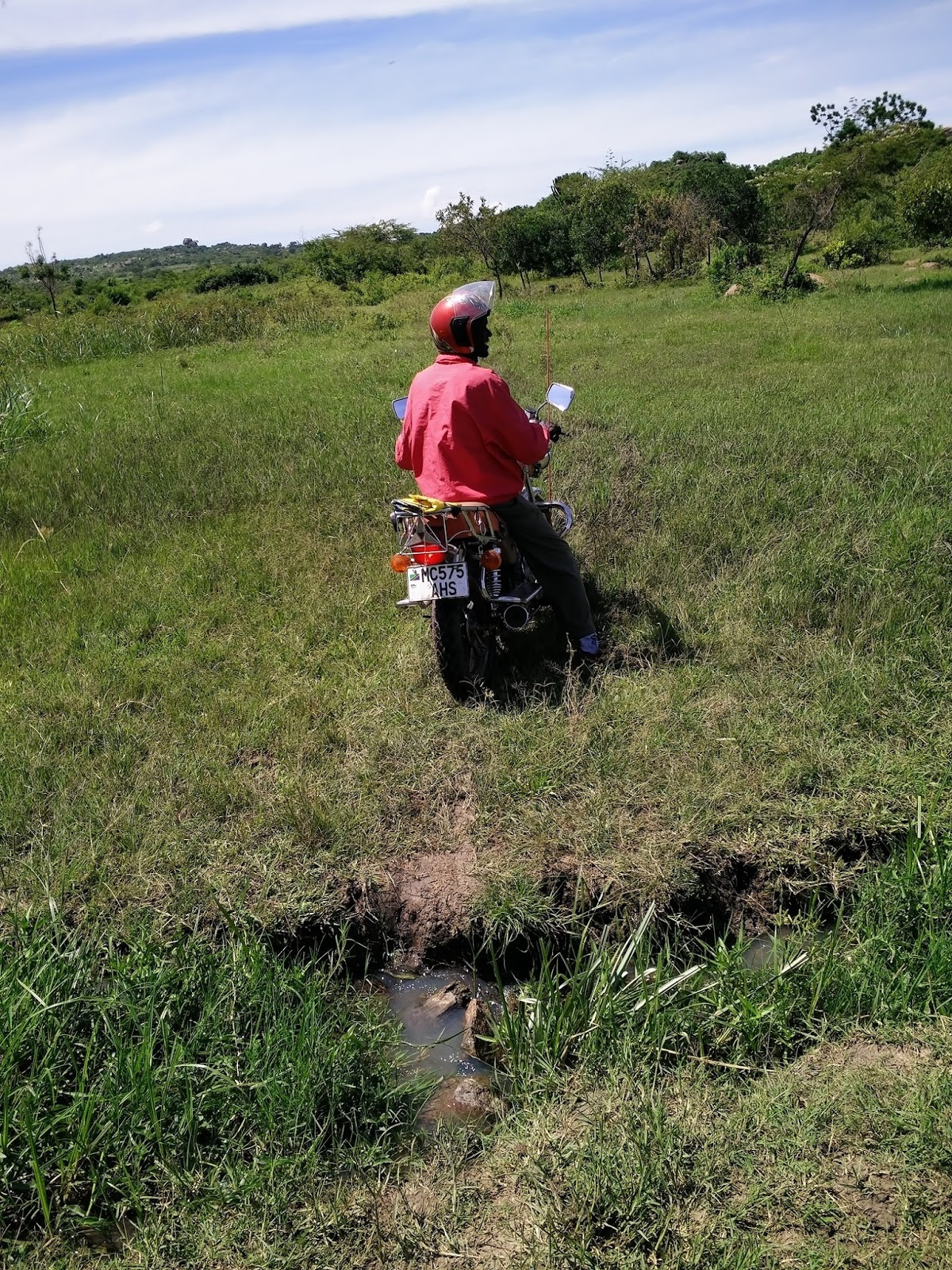
Some of the homes they were going to were off-road, to say the least!  Wesley told Fred "This isn't a safe place to drive!"  The next home was of a family which had received a new house from Shantz Mennonite Church.  The HIV+ single mother who was the intended beneficiary of the house died the day before the Shantz team was to build the house, so instead they gave money to build a new home for the orphaned children later on.


When Fred, Stephen and Wesley arrived on Christmas morning, they found that the two young children are now being cared for by their teenage sister-in-law, who also brought her young sister to live there.  Milka, that child bride, probably an orphan herself, was so ill that she was lying on a mat in the compound. All the kids were gathered around watching her suffer. There was literally no food in the house.  None of them had eaten the day before and there was not even a match to light the fire. The children's faces when they saw the cookies and food brought tears to my eyes.

The next home was of a man Fred has been interacting with for several years.  Ramadhan has been paralyzed from the neck down since adolescence.  Through the palliative care he receives medicine to manage the chronic pain he lives with, and he has used the gifts from that program to start a small business selling bars of soap and matches to people in the neighborhood.  Prior to the visit from the Shantz Mennonite team, he would spend all day lying on his mat in front of his home in the glaring sunshine or pouring rain. The team built him a shade so that he can be more comfortable while doing his business. His elderly mother who cares for him was given the food to prepare for their meal.

The next stop was to a family we've never met before, but Stephen knows their situation well.  Saidi was a palliative care client of Stephen's who died in the past year from AIDS. His widow and children received a new roof on their house from a Canadian woman who visits each year to do projects like this.  When they reached the house yesterday, they found the door closed, so they started walking to find Mrs. Saidi and encountered her returning from a neighbor's house where she had gone to beg food for her toddler.  All that boy was going to eat for Christmas was a piece of chapati that the neighbor had flung in his direction.  As you can see in the photo,  he couldn't take his eyes off those cookies!  The baby girl has no clothes, but we have a bunch of baby clothes donated for Mama Maisha, so Stephen will return with some clothes for that little one.

Last February Fred worked with that same Canadian lady and gift from our friends, the Rickeys, to build a house and water system for this widow and her two grandchildren, who had been living in a tiny, dilapidated house.  They met the ladies coming from church.  The grandmother, Lucia, said she had to go to church to worship because God has done so much for them this year.  Asking some questions, Stephen found out that they really had very little food in the house, and nothing special to eat for Christmas day, but still they were giving thanks. How many of us could find that faith?

Johanes was the very first client I ever met in Shirati.  He is a paraplegic who is in the palliative care program as well.  This year a friend of ours in Newberg paid for Johanes to get a new house and a new bed and mattress.  Johanes is so proud of his new home, and eager for his new water tank, courtesy of a British friend.  They found two neighbor boys there chasing a snake out of the house. We are concerned about his security, since he has no phone and can't move to find help, so Fred is looking for a special low-power cell phone and flashlight to help increase his comfort still more.


Obadia is another client of Stephen's who lives in a village on the lake front.  He is also paralyzed and sits in the market area, where people might bring him a fish from their catch for him to eat or to sell.  Often those with physical or mental disabilities are neglected by their families, and they rely on whatever support the community can provide.

This was the end of Wesley's rope, although he did a really great job spending three hours on the back of a motorbike (hence the helmet) with an empty stomach himself, handing out Christmas cookies to other kids.  Inno has a bad cough or he would have gone as well, because we think it is so important for our kids to have exposure to poverty and difficult circumstances, and to be part of serving the vulnerable.  It is one of the major blessings of living in rural Africa as a family.

Stephen and Fred dropped Wesley off at home and went to one last house.  Lucy and her teenage son were living in a very poor house, practically homeless in fact, until last July when the Shantz Mennonite team came and built her a new house.  Their hand prints are in the mud walls of her house, and she is very proud of this home. She is making small improvements, even though she is lame and walks with a cane.  Fred and Stephen arrived at lunch time and found no food or cooking fire, so she was very appreciative of the food they brought.  She wished they could stay so that she could cook for them and share a meal, but both men had their families waiting at home, so they excused themselves.

We love working with Stephen because of his great heart, and he told Fred that for him, this is the very best way of celebrating Christmas.  Although we couldn't go as a family, these stories really impacted us all.  Having Wesley to represent us made the clients feel like this was really a gift from our hearts to them, not a project, and bringing our young son into the homes of clients communicates that we are not afraid of their illness, a stigma that keeps many people away.

We want to take this chance to thank the many donors who have contributed to these families or to our personal support.  These financial gifts enable us to live here and engage with the most vulnerable people in our society, meeting physical needs and offering love and fellowship to many who sit in dark corners.  If you have been part of our support team, you are part of this work!

If you would like to help us continue caring for the widows, orphans, and other vulnerable people, please click on the button below to give a one-time or recurring monthly gift to our support.  If you'd like it to go to one of these clients in particular, just email me to let me know how you'd like your gift to be used.

Merry Christmas and Happy New Year!


12 December 2015

Inno Learns About Living with Disabilities

 This past week we were invited as a family to participate in Mennonite Central Committee's camp for Tanzanian children with albinism.  These kids were invited by all over the region to come meet at a primary school in Musoma.  In order to have camp at that location, which is host to about 40 children with visual impairments.  So there were about 90 children with either albinism or visual difficulties, plus Innocent.  The theme of the camp was "I am Valuable" and the kids took classes on Character Building and Health and played games and did crafts.  Fred was helping to teach a class on Peace Making (he took the photo below of Inno with a couple of his group members), in which the kids learned about the differences between "green communities" where peace and justice are present and "red communities" where chaos prevails, among many other things.

Children with albinism face many obstacles in Africa, particularly in Tanzania.  They are hugely misunderstood, especially when born in remote villages, where people call them derogatory names and sometimes believe that they are not really human.  People with albinism are sometimes hunted and killed or maimed; their body parts are used by witch doctors in charms which are said to offer business or political success.  An albino's body can sell for hundred's of thousands of US dollars, an enormous fortune in the developing world.  In Tanzania it is more likely for a child to have an arm cut off, sometimes by a neighbor or a relative.  These kids live under nearly constant threat, so the Peace Making and Character Building classes' lessons on forgiveness carry a heavy weight for them.

Additionally, the unique health concerns of albinos are not well known by their caregivers, so they suffer very painful sunburns and lip blisters from sun exposure.  Their eyes are weak, so many people develop partial or total blindness.  These health concerns are not usually accommodated by primary school teachers, who may require the students to wear short sleeved shirts and shorts without a hat for school uniform.  Some teachers require the albino students to sit in the back of the classroom where they cannot see the board, or in a window or doorway where they are exposed to sun throughout the day.  Many African albinos don't live beyond age 30 because they develop skin cancer from sun exposure and die extremely painful deaths.

Like all African kids, the albino kids were very interested in Wesley and Gretchen.  It took the better part of the week for Wesley and Gretchen to get used to all the new kids, but by the last day they were playing with the kids and having a great time.  Innocent did such a great job of playing with all kids, regardless of their skin color or disability.  His best friend at the camp, Iddi (at Inno's left in the photo at left), has pretty bad chapped lips, such that his mouth is often bloody.  It looks a little gruesome, but I loved that Inno didn't judge his friend.  During the last night talent show, Iddi and Inno did acrobatic flips together.  Their other friend, Chacha (in the yellow camp shirt), volunteered to be the first kid to show a talent, and he sang a kind of hip hop beat song. Wesley, who loved Chacha, stood next to him watching intently through the whole song.  It was pretty adorable.  Their friend Gilbert, at the far right, did a hilarious range of crazy laughter...probably the favorite talent of the whole show.

One day of the camp they took the kids on safari into the nearby Serengeti Park, so Wesley, Gretchen and I went to the beach to play.  A couple of the American volunteers who didn't need to go on safari went with us, including a new friend, Wendy, who is a teacher living in Tanzania almost as long as I have been.  It was really great to talk with her about our common experiences.  We were really glad we decided not to go on safari, since they got stuck in the mud several times and didn't arrive back until 1:30am!  The photos we saw in the camp's closing ceremony showed albino kids helping blind kids jump across muddy ruts in the road, and we heard stories of trying to find non-snake-infested shade for the 50-some albino children to share while the buses were pried loose from the mud.

As our family contemplates getting involved with the MCC village level program to do education and peacemaking regarding albinism, it was really a privilege to spend time with the kids this week.  It took the issue of albinism out of a purely social justice realm for me and into a much more personal issue.  Just like Fred was teaching them in class, a sense of compassion should lead into kind acts, which reflect personal integrity and responsibility.  Now when stories about violence against albinos appear in the news, Gilbert and Iddi and 89 other children's faces will come to my mind, and I hope to yours as well.


03 December 2015

Not My Words - A Tribute to my Sisters Abroad

I've been reading some blog posts from the "a Life Overseas" blog that have encouraged, inspired and challenged me.  They make me think of so many of my friends out here in the world abroad.  If you are, have been, or would like to be a woman in the mission or development fields overseas, read some of these very real pictures of life as a woman, especially as a wife and/or mother, in a cross-cultural environment.

Good Will Come: Views on Suffering
I read this today and felt so encouraged.  I have come to many of the same "gray areas" myself.

Missionary Mommy Wars
I've been able to avoid a lot of these pressures, due in huge part to my gracious husband and his low expectations, but I've seen this in so many friends' lives.

If I'm Perfect
This nailed me.  There are many sentences in here that I could have written myself, about myself.

When Spouses Travel
Fred travels a lot, but lately I've also been doing some big trips.  This was a great read with good advice as we enter a season of more and more opportunities for travel.

I dedicate all these links to the women who, although spread around the world, are some of my dearest friends.  Although we don't get to speak often, due to terrible internet connections, major time zone differences, many small children, and the normal busy-ness of missional life abroad, they love and understand me at such a deep level. I have deep admiration for you who have chosen this crazy life.

Thank you, and I love you all...

Corrine H, Haley B, Liz S, Mandi S, Tiffanee W, Vangi T, Melinda K, and recent friends Sarah, Charity and Susan, along with others I may have forgotten

27 November 2015

Our African Thanksgiving

This was the fifth Thanksgiving I've celebrated while in Africa.  

The first one was in 2008, in Adjumani, Uganda, while traveling with my newly married co-workers, the Angotes, and two visitors from Warner Pacific College.  We got to celebrate with two one-year American volunteers and a friend of theirs.  We ate pretty authentic food and played a raucous game of spoons.

The second one was the next year, in Dodoma, Tanzania, which passed almost without our noticing.  I think Leah and I went to the Pakistani cafe for lunch.

The third one was in 2011, when we had been married seven months and Inno had just come to live with us.  I can't remember doing anything special that year either.

The fourth Thanksgiving, 2013, was also here in Shirati. I was pregnant with Gretchen, my friend Liz was pregnant with her second son, and our friend Ladine was pregnant with her third baby.  Their husbands and kids, along with our Dutch friends Pim and Yvonne and their daughter, all came over to our house for Thanksgiving.  We ate a full potluck-style spread, and we pregnant ladies all got ultrasounds.  Y'know, standard Thanksgiving.

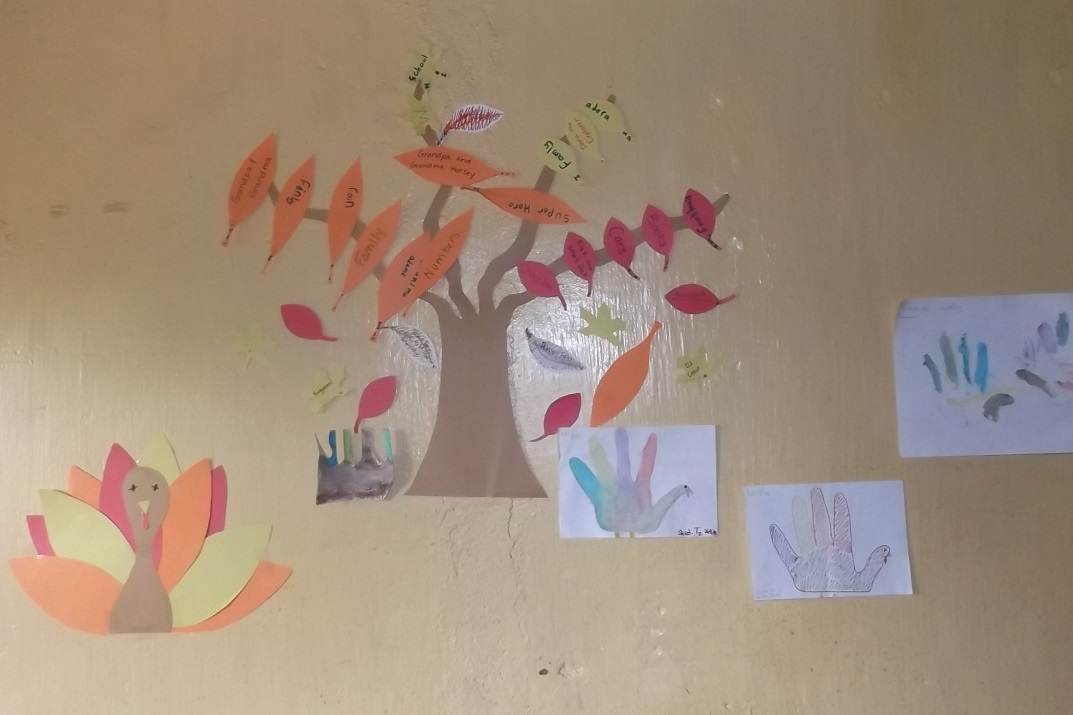
This year we have an American guest staying with us.  Megan Jackson is a Lahash Servant Team member who is staying on in Tanzania for another couple of months, and is taking a three week break here with our family.  She helped the kids put together a gratitude tree and some hand turkeys.  When I asked Wesley what he is grateful for, his first answer was "Letter W" followed by "Numbers."  I asked him what Gretchen is thankful for, and he replied, among other things, "Fish and small fish."  (Small fish are tiny silver fish we call dagaa.  It's a common food here which Gretchen really enjoys.)

All day long I cooked, and Megan helped.  Thanksgiving, my favorite holiday, is probably the day I feel most American out of the whole year, and it was nice to share with a fellow countrywoman.  After dinner, Innocent and Megan and I played Ruckus and SkipBo. It was a pretty wonderful day, and a wonderful Thanksgiving!
Pickles and olives from Iraq, gravy from a packet from America,
homemade crescent rolls,
Shirati's finest chicken, carrots, potatoes and watermelon,
homemade juice for the kids and not the finest wine for adults!

I didn't have a pie pan, so we made little apple pies in silicone muffin tins.
The kids helped with measuring and stirring, then we carved initials in the tops.
This is Gretchen's, naturally.

Happy Thanksgiving from the Otieno Family!

17 November 2015

The Wrap Up of My Trip to Kurdistan

Day Eight - A Picnic

We were invited for a picnic at the home of the cousins of The Refuge Initiative's Project Manager.  The group photo at right is only half of the group we had lunch with.  The men in this family work in an informal sector in which they take goods over the mountains and return with sale-able merchandise that is *ahem* untaxed.

After a lovely outdoor lunch in a village halfway to Turkey, we went to see the nearby mountain creek that their drinking water comes from.  I am a little embarrassed at how little I knew about the varied terrain in the Middle East.  This was an incredibly restful and beautiful day.  In fact, I owe an apology to my boss at Lahash, because I'm always skeptical about taking time away from work and relationship to go hiking.  On this afternoon I felt my spirit renewed for another week of engagement with the refugees.  After returning to the house, we heard the wholly miraculous testimony of a Kurdish believer who now lives in Beaverton, Oregon.  His story renewed my faith that God can redeem the worst of men or women (no offense to Sami).

Day Nine - Equal Parts Work and Play

The most distinctly different thing between the Middle East and anywhere else I've ever traveled is that Sunday is a very standard weekday.  We went to a couple of camps in the morning, where I was shown the traditional method for making bread.  The bread is a cross between naan and chapati. This woman kneading bread is the person I learned so much from, although we shared no language in common.  She answered so many questions (through translators) over the course of my visits to their camps, and even when there was no translator, she was so welcoming and comfortable just hanging out in silence.  At dusk we went up one of the mountains in a gondola for Indian and Italian food at a ski resort.  (I didn't mention it, but on our first day of work we went to a resort with a roller coaster which shot over the edge of the mountain at one point--totally exhilarating!)  After dinner a couple who are connected to the staff of The Refuge Initiative came over to probe my knowledge of maternal health by asking for help on getting pregnant and preventing miscarriage.  I gave them all the advice I could (the vast, vast majority of it was extremely practical and not at all medical) and referred them to Dr. Niyan who could refer them to a good OB/GYN.  One of my team members, an actual medical professional, and I had the privilege of laying hands and praying for the mother-to-be.

Day Ten - Politics and Perspective

In the morning we visited the mayor of Soran, who has been incredibly kind and helpful to The Refuge Initiative.  (They've solved some not-inconsiderable problems for him as well.)  A large part of Kurdish culture is militaristic, due to the long, long history of being targeted for destruction by their neighbors.  There is a Kurdish saying that "The mountains are our only friends" because of the many times they have been able to defend themselves against incredible odds due to the rugged terrain.  Nearly every young man (and many young women) volunteer for the peshmerga, a term you may have heard in connection to ISIS, since the peshmerga are the only military which have had success battling ISIS on the ground (and just recaptured Sinjar town from ISIS).

That afternoon some friends of our Kurdish friends came over with their 3-week-old baby who had been crying to the extent that the parents were getting very overwhelmed.  The nurse and I took a look at the baby, who is a healthy and beautiful little girl, and advised the mother on feeding and using simethicone drops.  I also showed her the things that had worked for my kids: abdominal massage and "cycling" her legs to help release the gas trapped in her gut.  Pretty pragmatic stuff, but it felt good to help a fellow mother.

In the evening we got to have a time of worship with the other Western Christians living in Soran.  It was such a blessing to me, since that kind of community is one of the things I really miss here in Shirati.  The stories I heard that evening so inspired me.  I felt as though I were sitting in the room with the kind of missionaries I used to read about.  I can't say more than that, but it really puts the complaints of American Christians "oppressed" for their faith in perspective.

 Days Eleven, Twelve and Thirteen - Maternal Health

At long last I got to tap into my new speciality: maternal health.  Dr. Niyan joined me again to translate the teaching.  She did an excellent job with a difficult task, since she was translating medical and anatomical terminology from English (her 3rd+ language) into Arabic or the Kurdish dialect spoken by the Yezidis.  We taught the women basic reproductive anatomy, the processes of healthy reproduction, some of the most common things that can go wrong and why medical care is important, and finally, we did a simulated "emergency" delivery outside a medical facility.  I had brought hygienic birth kit materials for each camp, thanks to the really kind donors who sponsored my trip, so at each camp the women nominated one older woman to be the keeper of the plastic sheet, gloves, gauze, umbilical clamps and sterile razor blades.

The forty-ish women who sat through our four seminars were so attentive and asked great questions, even about contraception.  Part of the great thing, though, is that there are so few opportunities given to women in these conservative cultures to learn new things, and they were so grateful.  I am so grateful for my dear friend, Dr. Reta Graham, who taught me nearly everything I passed along to those women.  Without Mama Maisha, I would have had so little to offer them, but because of this path that God has been leading me down these past few years, I had the opportunity to minister to so many women from Muslim and Yezidi backgrounds.

After the teaching, Dr. Niyan translated about an hour of questions I had for the women about their former life on Sinjar Mountain and how they had escaped ISIS.  I heard a great story about the cousin of one woman present who had been captured by ISIS and bussed to Mosul with the hundreds of women who have been sold as domestic and sex slaves.  This cousin and her sister were sent to a home where they were put to work.  One evening they actually escaped the house and encountered a taxi driver who agreed to help them.  He knew that he couldn't take them outside the city because the ISIS checkpoints were everywhere, but picnicking in the countryside is a very popular Kurdish pastime.  The driver took the young women to his home, dressed them like local Muslim girls, and packed up his whole family for a picnic in the country.  Once they got outside the city, the driver just drove and drove until they encountered the peshmerga, who took the girls and got them to safety.  (God bless that taxi driver who risked so much to help them!)  Over the few weeks they were at that home, they were never sexually assaulted.  The women telling me the story speculated that this was because the battles for Mosul and the surrounding area were still going on, so the men of that home were more concerned with fighting than with raping two young women.  I appreciated hearing this dramatic story with a great ending, since the vast majority of Yezidi women who are captured by ISIS suffer much worse fates.

The day after I left Kurdistan, I got notification on Facebook that the woman we I mentioned in a prior post had given birth at home in the camp, just two days after Dr. Niyan and I had been there to give education and supplies!  The beautiful little boy is healthy, as is the mother.  Thank God for bringing the blessing of life!

I'm home now, and processing so many, many, many thoughts, especially about refugees and how to respond to the attacks on Paris and the refusal of many American governors to accept Syrian refugees in their states.  I wish you all could meet the hundreds of refugees, male and female, young and old and very young and very old, who are in need of safety, security and support.  Kurdistan is helping so many refugees that the region is literally going bankrupt, but many of my countrymen and women are refusing or protesting these beautiful families whose "crimes" are being born into an ethnic or religious group of which ISIS does not approve.  

I keep thinking: If I were a young child who had been forced from my home by a violent hyper-religious military force and lived in an under-resourced, insecure refugee camp for more than two years (the amount of time it takes to be screened for placement in America), then my family was brought to the United States for safety, refuge, freedom, education, medical care and food, among many other things...well, radicalism of any kind would probably be the last thing I would want to be a part of.

On the other hand, if I had gone through all those things and kept being rejected by these rich Western countries because my ethnicity and religion were not acceptable to them either...well, my perspective on the West and Christianity might be very different.

Please consider supporting The Refuge Initiative, the section of World Orphans that is caring for the refugees we met these past two weeks.  They are doing some of the best, most sustainable and cost-effective development work I've ever seen.  They need your help to provide more holistic services to the families, so please go sponsor a family or contribute to the construction of secure, cinder-block homes to transition refugees out of tents. 

Finally, thank you, especially to all of you who were praying for us and who supported me financially.  This trip was so powerful, and I'm incredibly grateful.